Start: “The puddle is smaller. Choose a possible explanation.”
Purpose: Explain evaporation as liquid water becoming invisible water vapour; distinguish explanation from observation.
Prepare
Read today's complete model and two contexts before the session. Paper, a pencil and the full written picture words are sufficient. Optional actual water work follows ordinary preparation; the teacher chooses suitable familiar materials/instruments. Use today's three routes without assigning a fixed learning-style label.
Run the session
-
Reconnect: return to a liquid water place. Introduce the supplied picture pair “same marked patch: wet earlier, dry later”; the drawings are made-up evidence.
-
Model: “I can see less liquid water. Some water could have become invisible water vapour. That change is evaporation.” Contrast what was shown with the proposed cause; other routes such as soaking need other clues.
-
Try: place liquid-water and vapour-in-air cards with the evaporation link. Optional teacher-managed tiny room-temperature tray observation begins with an actual dated starting record and remains open if no clear change occurs.
-
Compare: use a towel patch and a rain puddle as different contexts. Less visible water alone cannot establish how much evaporated, exact timing or that no water soaked/spilled.
-
Make: produce a two-state explanation. Use words, arrows, two spoken lines or the first Water Trail link. Show vapour as labelled empty-air space, not a cloud.
-
Exit: “Evaporation changes __ into . One clue I would look for is .” Accept scientifically equivalent wording.
Three ways in
Two-card switch
Use labelled liquid / invisible vapour cards and an evaporation arrow; reposition by eye or ask a helper to move them.
Worked ordinary reasoning: Liquid water can become invisible water vapour in air.
Observation notebook
Observe an adult-approved tray from a dry safe place; draw or dictate what is actually visible at each review time. Keep explanation in a separate line.
Worked ordinary reasoning: I recorded the starting mark. I have not yet seen a clear change; I cannot invent a final amount.
Clue editor
Edit “the water vanished forever” into a useful supplied-picture caption; pick or compose words instead of handling water.
Worked ordinary reasoning: There is less liquid water in the picture. Evaporation is a possible explanation; the drawing alone cannot rule out soaking.
Look and choose the next teaching
Liquid-to-gas meaning and an observation/explanation distinction; no requirement to see vapour.
If vapour is drawn as drops, reteach the two state labels and the invisible-gas limit before condensation.
Today's complete resources
A02 · whole labelled picture · Complete terms · A02 · complete picture words
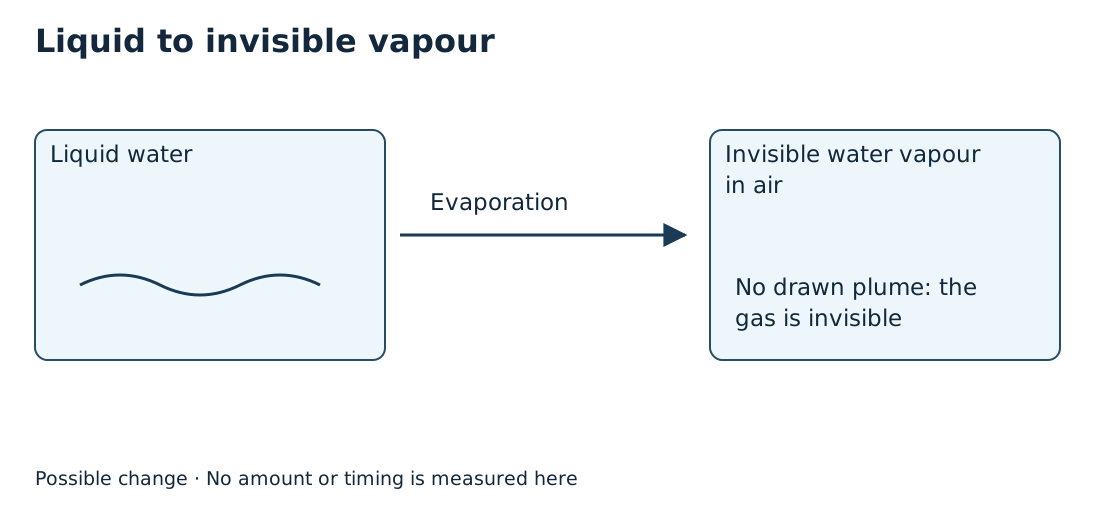
A05 · whole labelled picture · Complete terms · A05 · complete picture words
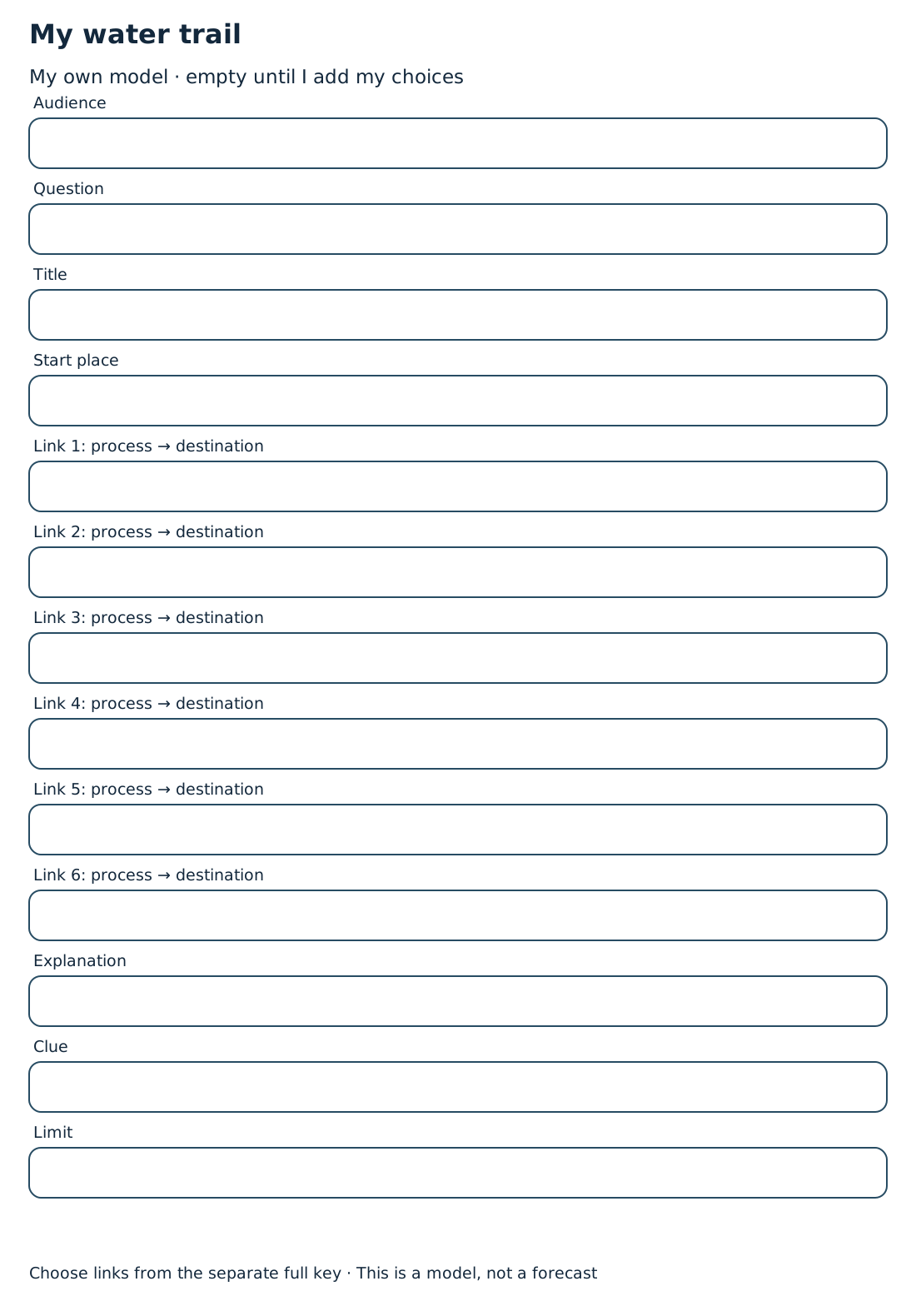
Short child start · Written read-aloud · Water Trail and paper
Partial opportunities: AC9S4U02, AC9S4I01, AC9S4H01 · Full mapping and limits