30 September 2026 · author simulation and rendered artifact inspection. No teacher, parent, child, funder, classroom, compound suitability/physical making or external cultural review trial was conducted. The roles below are author perspectives, not participant feedback. No learning-gain or universal-access claim.
Teacher pass
Prepare the actual locally approved familiar compound/setup before any physical route; this pack supplies no recipe/product safety certification. Read only the day's script/short prompts and the page useful for that decision. Six stages total 25 minutes (3+4+5+7+4+2); supports/assessment components may continue later. The 3–5 minute choosing phases and seven-minute making phase are intended manageable starting allocations, not measured child timings.
Sequence is concrete: first broad form → one little try/keep/change → two-form composition → own focal choice/bounded diagram purpose → fresh AC → agreed near-edge arrangement → viewpoint/unknown → optional response/private refinement → truthful maker note/use → fresh AD. Art intent and process remain central. No joining, tall construction, copying cultural motif or promised durable result. Adult shaping, child direction, actual original drawing and represented unmade sculpture are separately recorded. If compound/setup fails, keep a complete art drawing/development route without fabricating a material event. Actual learner physical modelling remains unavailable until supported later.
Checks are held, with first response before key/models, exact supplied facts and original open art decisions. Teacher key fixes source representations/status and offers possible personally meaningful choices, not one preferred arrangement. E01 is narrow actual supplied-graphic encounter/purpose or an authorised optional work; P01 needs actual willing sharing. Context codes are separate evidence. Adult preparation/rights/source review creates workload; choose one useful aid instead of printing all eight.
Parent/carer pass
All ten home bridges can be imagined, spoken/signed or discussed without compound, tools, printing, device, purchase, home map, family disclosure or returned evidence. A parent can ask one playful question, such as what an imagined form could suggest, then accept privacy or no response. Fresh check sources/key are not sent as homework. No child loses credit for missing home evidence. If a family volunteers existing own artwork, permissions/status stay local; no uploads or public caption requested.
Student pass — author perspective
The invitation is “your little world”: a funny pairing, tiny imagined landscape, quiet looking place or abstract art the child names. Real choices are broad form, gap, focus/equal attention, viewpoint, title/meaning, route, keep/change and private/possible use. Keeping a choice is a decision. A child is not asked to perform fine handling, agree with a viewer, reproduce a named style, disclose a personal story or share publicly. A willing viewer may understand differently; the child still owns the work.
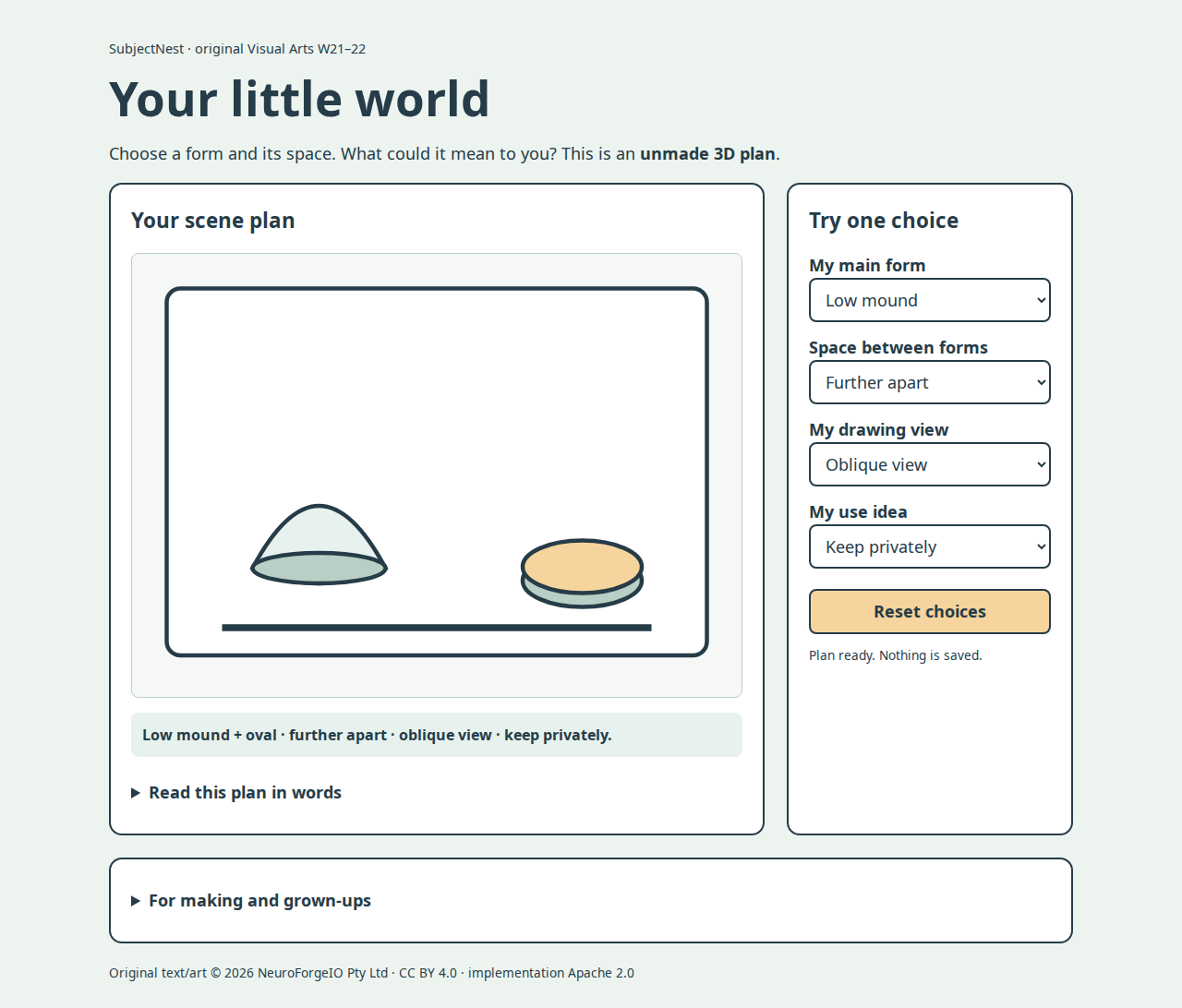
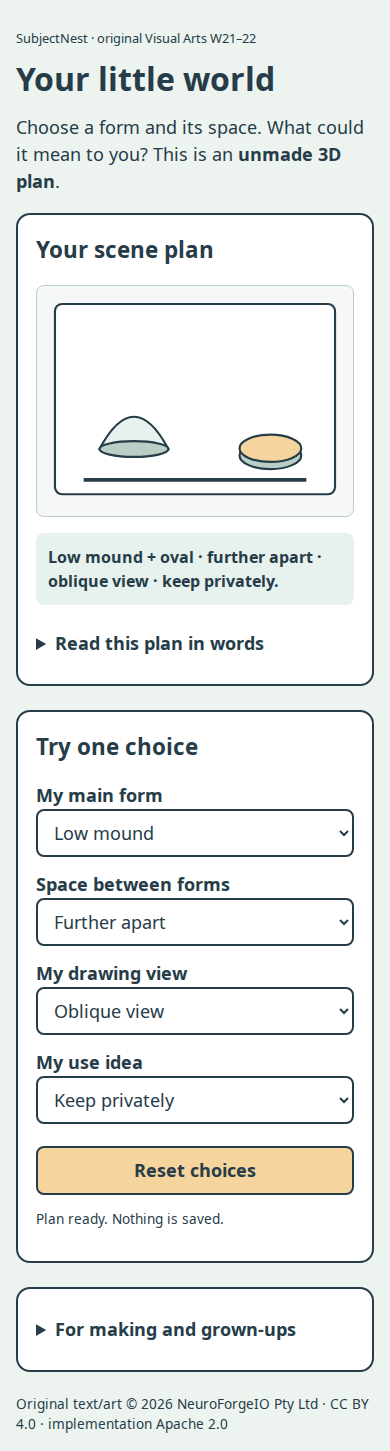
The printed evidence/status vocabulary and long teacher source notes would overload a child if read all at once. Adults read one short prompt or field. The optional screen opens with a picture and short phrase; source/process/privacy explanations are expandable, four controls are offered one at a time. On phones, art and controls stack and require scrolling; this is a practical limitation, not a claim of independent child reading. Paper/sign/AAC routes and exact spoken descriptions remain complete. No-JavaScript route hides dead controls and preserves an original static plan plus paper/directing prompt.
Funder/reviewer pass
This is an authored, reproducible practice pack with conservative source/rights/evidence boundaries. It is not certified curriculum coverage, a proven classroom intervention or evidence of actual compound outcomes. National workbook/import and actual source cells are pinned; fresh ACARA fetch matches. QCAA complete indexed alignment/three-page text inspected, direct requests 403 and current bytes/layout unverified. General museum process reference is for grades 6–12; no Foundation safety endorsement, copied artwork or third-party style claim. Narrow supplied original graphic identities/purposes are documented and distinguish actual computer artwork from unmade physical proposals. Community authority is not invented.
Original materials CC BY4.0; code Apache2.0; DejaVu licence separate; curriculum/museum/community-held rights remain their own. The default verifier hashes every pack file, rebuilds all sixteen print files in a temporary location and rejects five deliberate source/key/geometry/network/false-physical faults in temporary copies. Automated audit and author desk views do not substitute for independent educator/child/family access testing or local authority.
Actual rendered checks
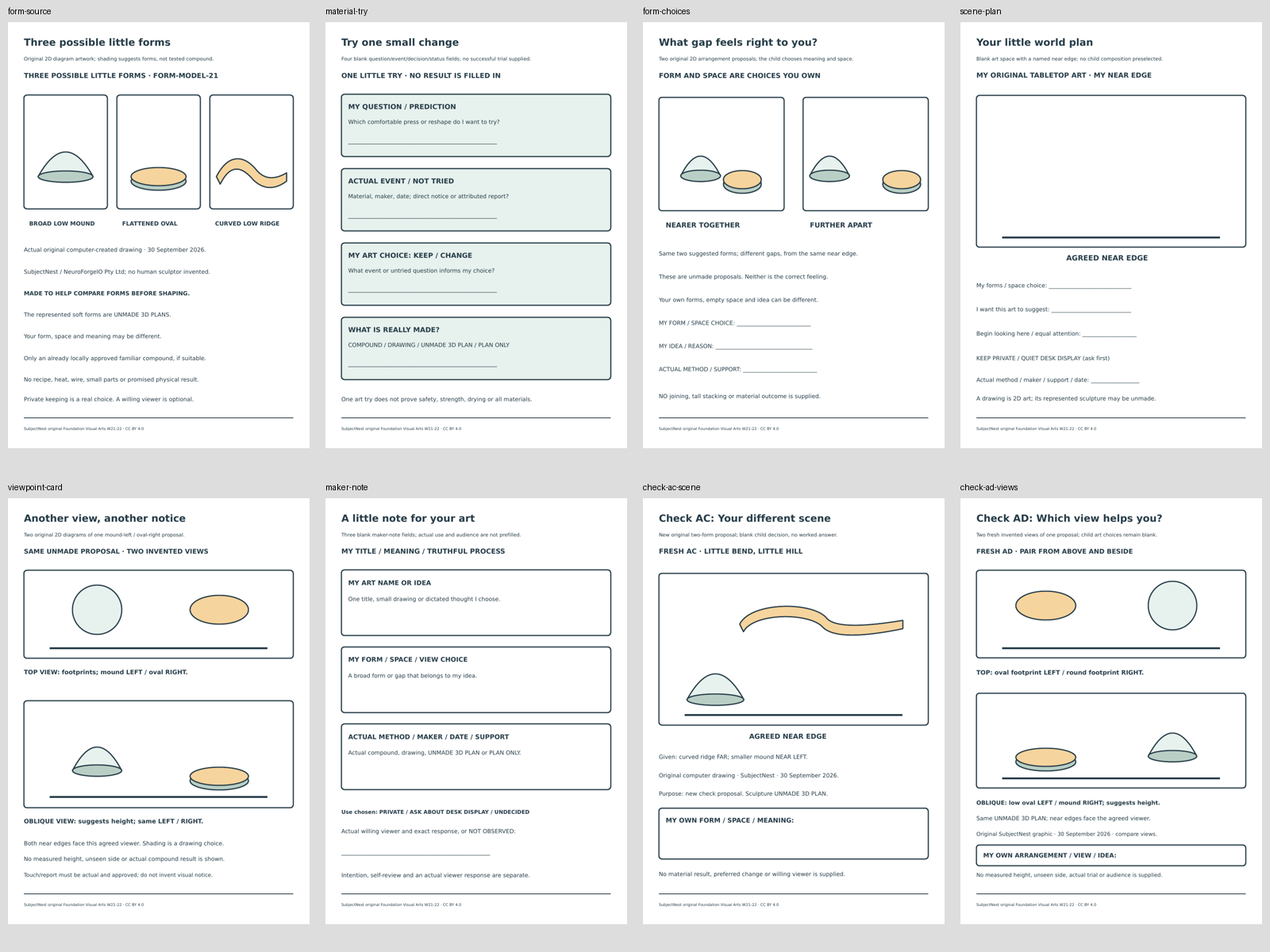
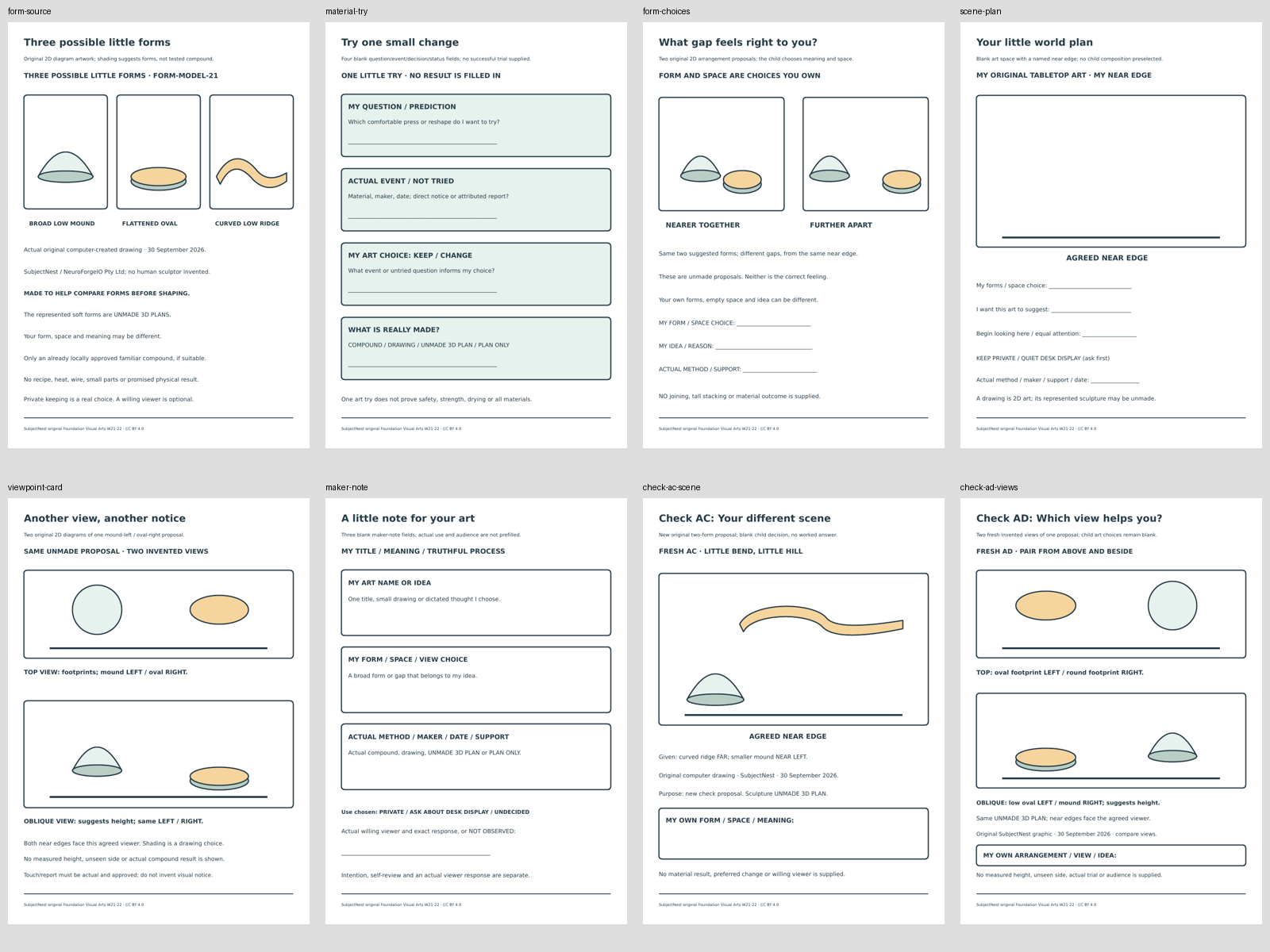
All eight actual PDFs, every page, were rendered at 1123px, inspected as the saved contact sheet · Download original PNG, and compared with exact SVG/PDF words and A4/text bounds. Fresh AD and source art were also inspected at full size. Diagrams, fixed left/right/near/far source features and blank response spaces agree with their exact alternatives/key. Initial dome proposals were lowered/broadened during author review to match low separate forms; final illustrations imply no tall construction. No print view proves tactile fit or physical compound success. Searchable PDFs are not tagged; the linear alternative is the reading copy.
Browser audit: 24 states × 1280/390/320 = 72, actual form/footprint/side nodes and their positions, exact SVG/linear alternatives, native option fit, diagram bounds, overflow and expandable text. Keyboard summary→controls→reset, native value change, reset/reload defaults, zero page errors/outside requests and empty storage checked. JavaScript off at all three widths gives complete paper/sign/AAC route and hidden controls. Actual desktop and 390px mobile renders inspected; 320px layout/expanded text independently inspected during author QA. Default verifier and browser audit were rerun after authoring; all 44 pack-file hashes including the manifest were unchanged before/after. The manifest covers 43 content/code/preview files; 66 local links and heading anchors pass. Five temporary-copy faults were rejected and removed: incorrect official row, leaked check answer, swapped fresh-view geometry, outside-network API and falsely physical supplied work. Every browser/context closed. Optional screen does not make compound, test material or produce real audience feedback.
Remaining human/local gates
- School reviews current full official sources, balanced programme and actual learner evidence before reporting.
- Adult verifies actual familiar approved compound/setup, local safety/hygiene/storage/privacy and each learner's access/comfort; no forced contact/assistance.
- Educator/child/family usability and access review; timings, tactile fit, language and making enjoyment remain unpiloted.
- Actual dated learner work, maker/support, material event or NOT TRIED and available direct view/report are recorded before any physical/process claim.
- Actual child/viewer agreement, safe approved display and exact response are recorded before audience/use claims. Private work is valid.
- Any external/community-held work needs primary provenance/rights and authorised local review before use; no such authority is supplied here.