Teacher copy: This page may include teaching prompts or answer keys. Answer keys in this public library can be viewed by anyone. Give learners a clean prompt, use checks as formative evidence, and change a case locally when prior access matters.
Resource Weeks 35–36 · Queensland Prep / national Foundation · flexible session, often 25–35 minutes with pauses. This is a resource sequence, not a school-term date claim.
Useful outcome
Explore a genuinely familiar designed feature when available; distinguish a noticed feature from an attributed use or guessed maker intention.
Before you start
Read Preparation, choose suitable available broad parts or a no-object route, and select C03 / C04 if useful. Keep first ideas before examples.
The session
Ask whether an actual suitable game, instruction routine or table arrangement is already familiar. The child need not name a household or recount personal play.
With an adult-approved example, notice one feature: a marked start, separate places or a cue. If no genuinely familiar example is offered, use a new original practice model and leave K01 actual familiarity open.
Select a mechanism below and preserve what the child actually points out. A picture description can support exploration without making an invented source personally familiar.
Offer an agreeing arranger's exact use account only if actually available. Keep who said it separate from observed form. Otherwise retain a question.
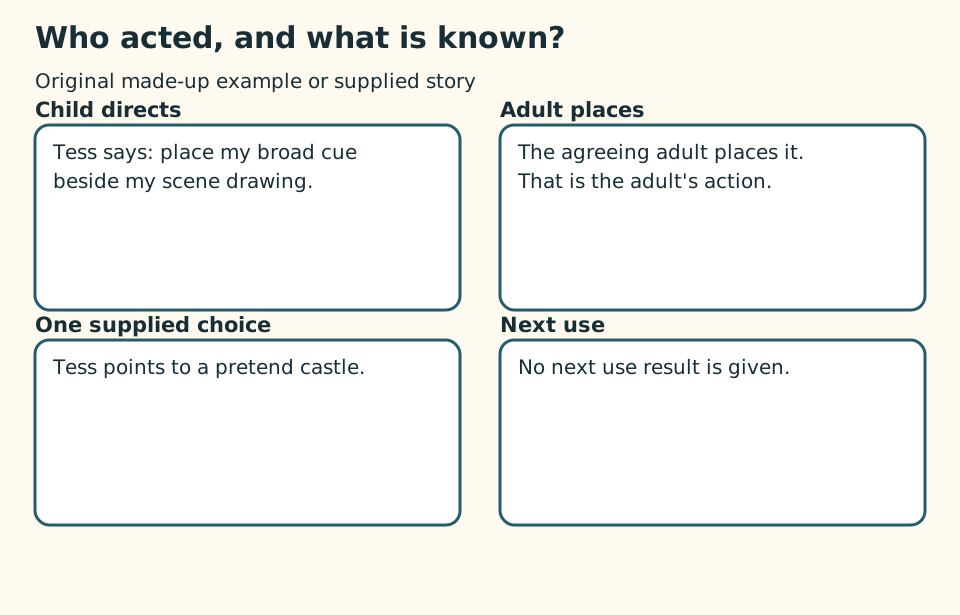
After own noticing, show C03/C04 ordinary fiction: a maker says why they chose a cue; another plan has no maker account. Ask what each source can tell us.
Keep one useful feature/question for the child's own new game. If purpose is guessed as fact, model 'I notice… / this person says… / I still wonder…' on a different ordinary object.
Choose an engagement route
Find a familiar feature: With an approved genuinely known setup, point to one feature. Draw or describe it, then keep one question.
Ask an arranger: Ask a willing actual arranger about a feature they chose. Keep their exact reply if given; otherwise keep the question.
Read two stories: Read C03 and C04. Place or tell what each says and what it leaves open. A new story does not become your familiar game.
Notice and teach next
Contexts: C03 invented broad-card chooser account; C04 pretend board plan with unknown intent. Observe: the real example and actual exploration for K01 only if offered; source interpretation separately. Next teaching: point to one noticed mark without claiming why every maker used it.
Source review is complete for this two-week edition. Local suitability and classroom use still need review. Earlier candidate or pending-review words are retained in the original files; full-year coverage, translations and audio are not claimed.
Labels and search exclusions are distribution guidance; they do not authenticate or restrict access.
Source: https://neuroforge.io/subjectnest/library/resources/foundation/design-and-technologies/term-4/weeks-35-36/teacher/day-172-markdown · SubjectNest by NeuroForgeIO Pty Ltd · Keep the complete source and licence companions; item rights remain separate.