A make-believe story. A helper can read it one part at a time.
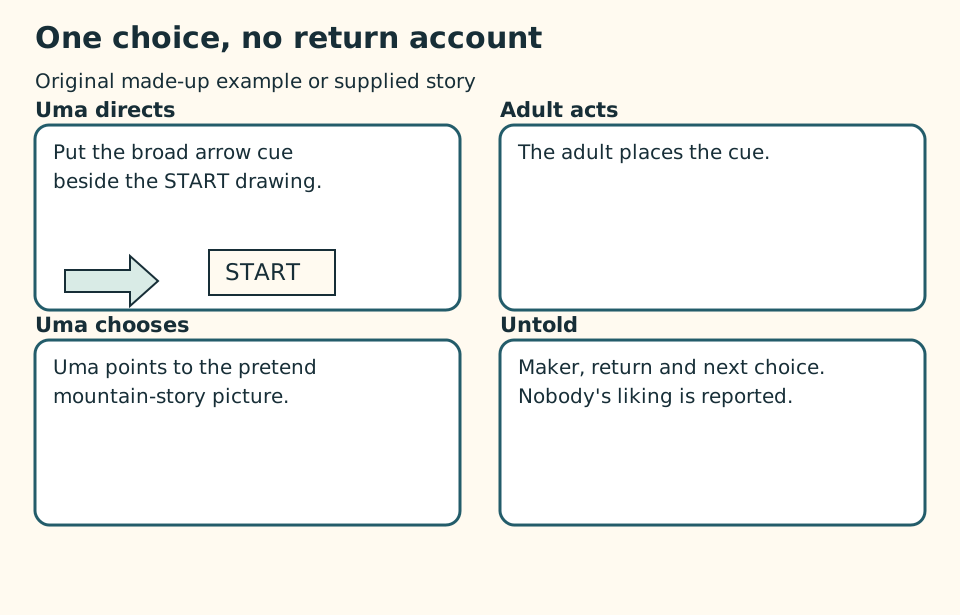
In an imaginary table game, Uma directs an agreeing adult to put a broad arrow cue beside a START drawing. The adult places the cue. Uma points to one pretend mountain-story picture. The account says that picture was chosen in this one event. It says nothing about who made the parts, whether any part was returned, a second choice or anyone liking the game. This supplied fictional event is not this real child's performance.
Your questions
Who did which action in this story?
What choice is given? What does the story leave untold about getting ready again?
What would you keep or change, or what do you prefer about this game idea? Why?
What could you check next? Who would act, and what would you look for?
Grown-up help
after actual actor/step/result/unknown/reset distinction instruction and ordinary practice, normally after Day 177. May be later. Source values are not ordinary rehearsal material.
Save an offered first idea before showing a worked example or a key. Record faithful access help separately from content/design help. Select only components actually taught and review exposure; the public forms are neither secure nor calibrated. Actual child making requires the child's own observed suitable action; adult manufacture is the adult's contribution. Actual familiar exploration is separate from interpreting a new fictional source. Never use response speed, handwriting, touch, compliance, sociability or length as design quality. These are original formative criteria, not official QCAA AP/MC/WW/EX/BA grading.
[Separate staff criteria](../staff/C-first.html) · [Assessment chooser](../teacher/ASSESSMENT.html) · [Full notices](../SOURCE-NOTICE.html)
About this resourceReviewed source edition
Source review is complete for this two-week edition. Local suitability and classroom use still need review. Earlier candidate or pending-review words are retained in the original files; full-year coverage, translations and audio are not claimed.
Labels and search exclusions are distribution guidance; they do not authenticate or restrict access.
Source: https://neuroforge.io/subjectnest/library/resources/foundation/design-and-technologies/term-4/weeks-35-36/checks/C-first-source-markdown · SubjectNest by NeuroForgeIO Pty Ltd · Keep the complete source and licence companions; item rights remain separate.