Day 40 · What is clearer now?
Start: “Try a new story if it helps. Pick your next water question.”
Purpose: Use later fresh forms only after relevant teaching and make an evidence-based next teaching plan.
Prepare
Read today's complete model and two contexts before the session. Paper, a pencil and the full written picture words are sufficient. Optional actual water work follows ordinary preparation; the teacher chooses suitable familiar materials/instruments. Use today's three routes without assigning a fixed learning-style label.
Run the session
- Reconnect: revisit the child's earlier actual response and what was taught afterwards, privately and without a class ranking.
- Model: use C19 to show a cautious improved explanation; later A–D stories remain different from all taught practice contexts.
- Try: give only the needed later form(s), full source access, usual aids and empty own-response questions. Split sittings or stop where needed. A whole packet is not a compulsory timed test.
- Compare: adult records each new actual response/support/date and compares like criteria with the earlier form. A missing attempt is missing, not zero attainment; no automatic improvement claim.
- Make: choose a next water question or a useful revision to the guide. Distinguish a question we can investigate safely, a source lookup and an unsupported weather prediction.
- Exit: “I can explain __. My next question is __.” Keep a specific teaching appointment if inquiry/actual instrument evidence remains unobserved.
Three ways in
Fresh paper story
Choose the relevant later A/B/C/D bundle with blank own-response page and a private ordinary sheet.
Worked ordinary reasoning: The adult compares actual responses to the matched criteria, not the amount written or time spent.
Supported source reading
Read the same full new source neutrally; use pointing/sign/dictation and record exactly the support, without supplying the science answer.
Worked ordinary reasoning: The record distinguishes the child's explanation from the helper's reading/handling.
Next-question studio
After the needed check, make a one-question card for a future safe inquiry or adult source lookup. Choose a drawing or dictated line.
Worked ordinary reasoning: A question such as “Would matching a longer review interval help us notice a change?” is investigable; the model cannot predict tomorrow's rain.
Look and choose the next teaching
Actual later response after documented teaching and a specific next step; no assumed full strand/year mastery.
Keep any unobserved actual conduct/measurement criterion open and plan an appropriate later supported opportunity.
Today's complete resources
A14 · whole labelled picture · A14 · complete picture words
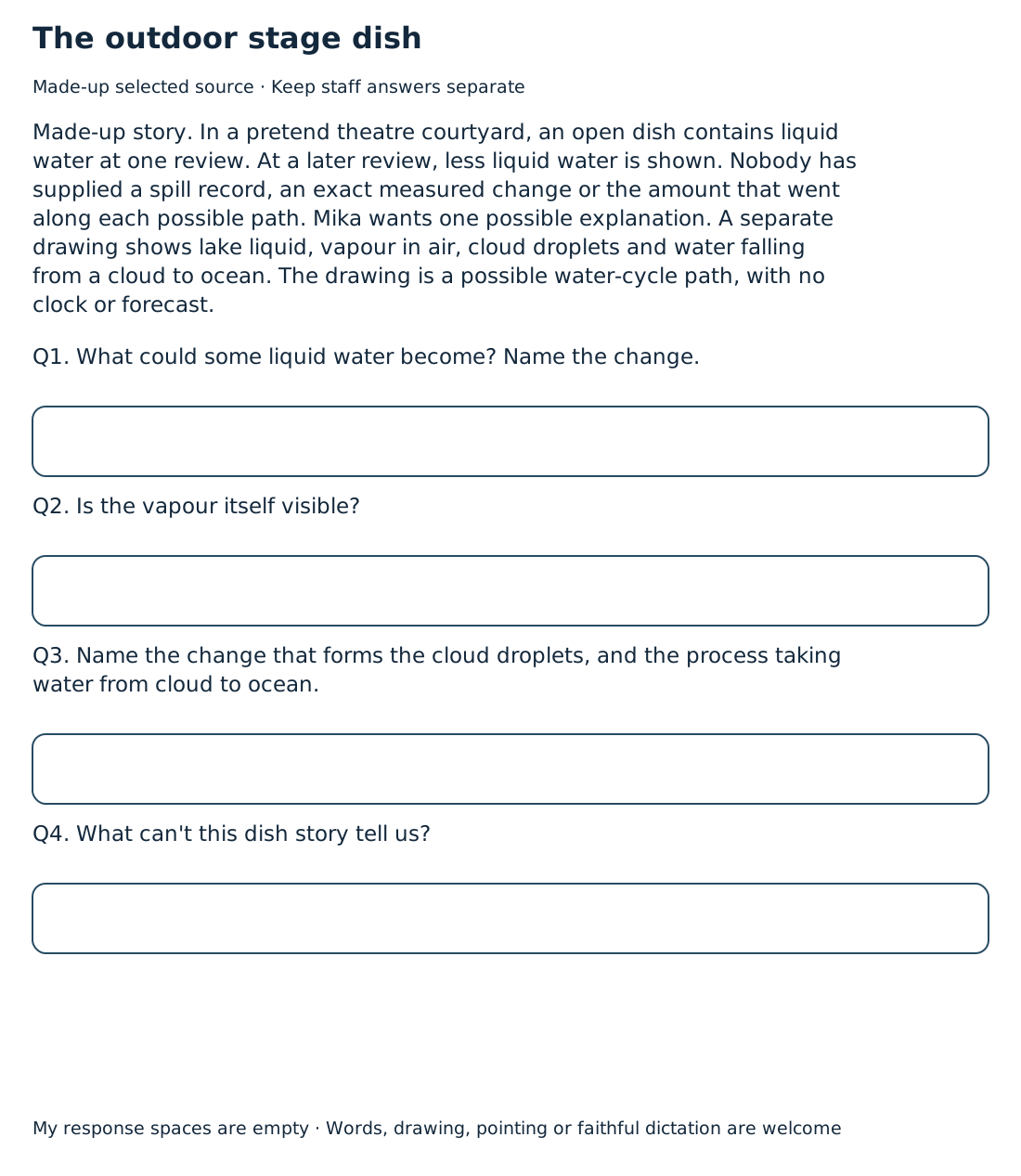
A15 · whole labelled picture · A15 · complete picture words
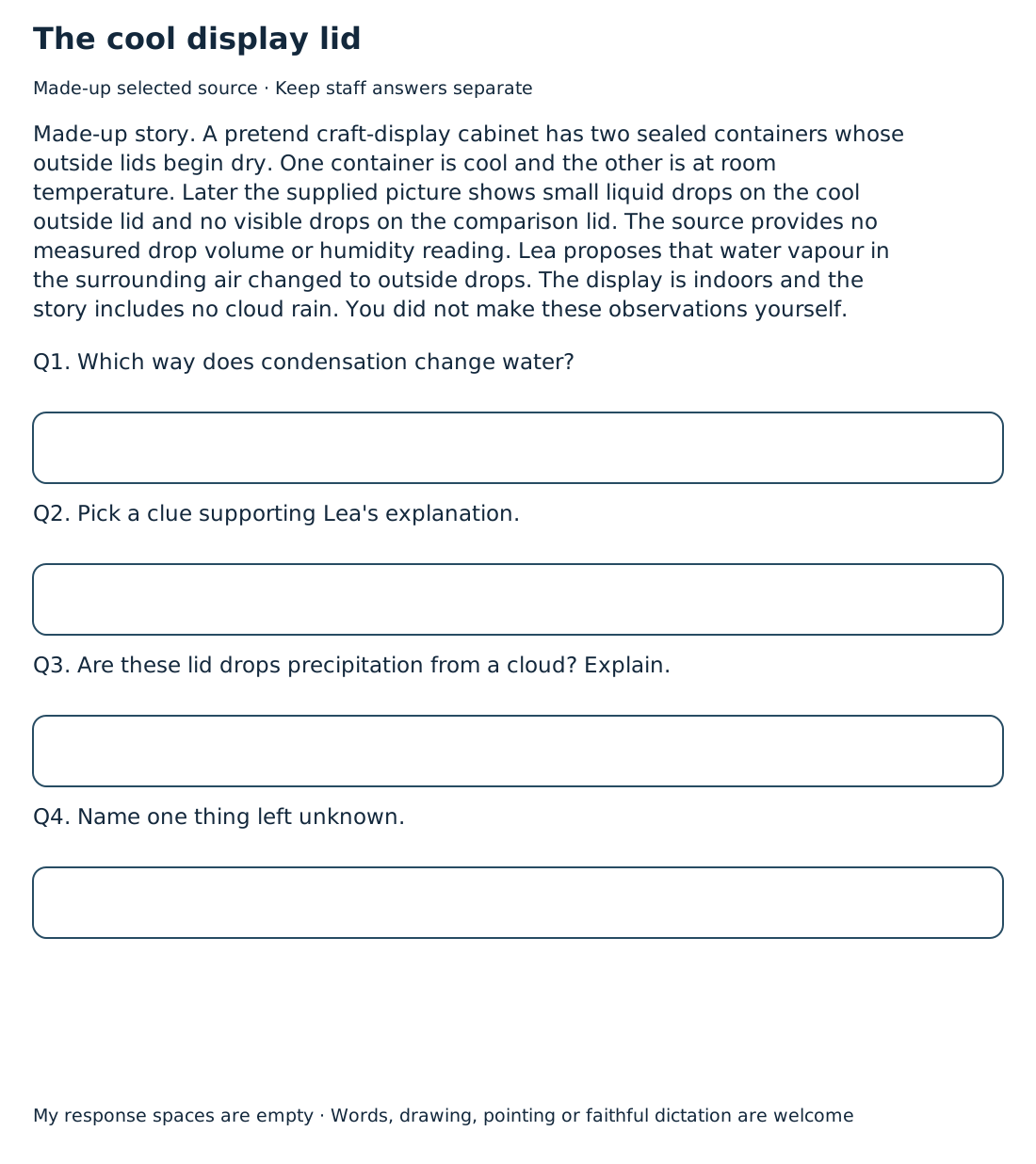
A16 · whole labelled picture · A16 · complete picture words
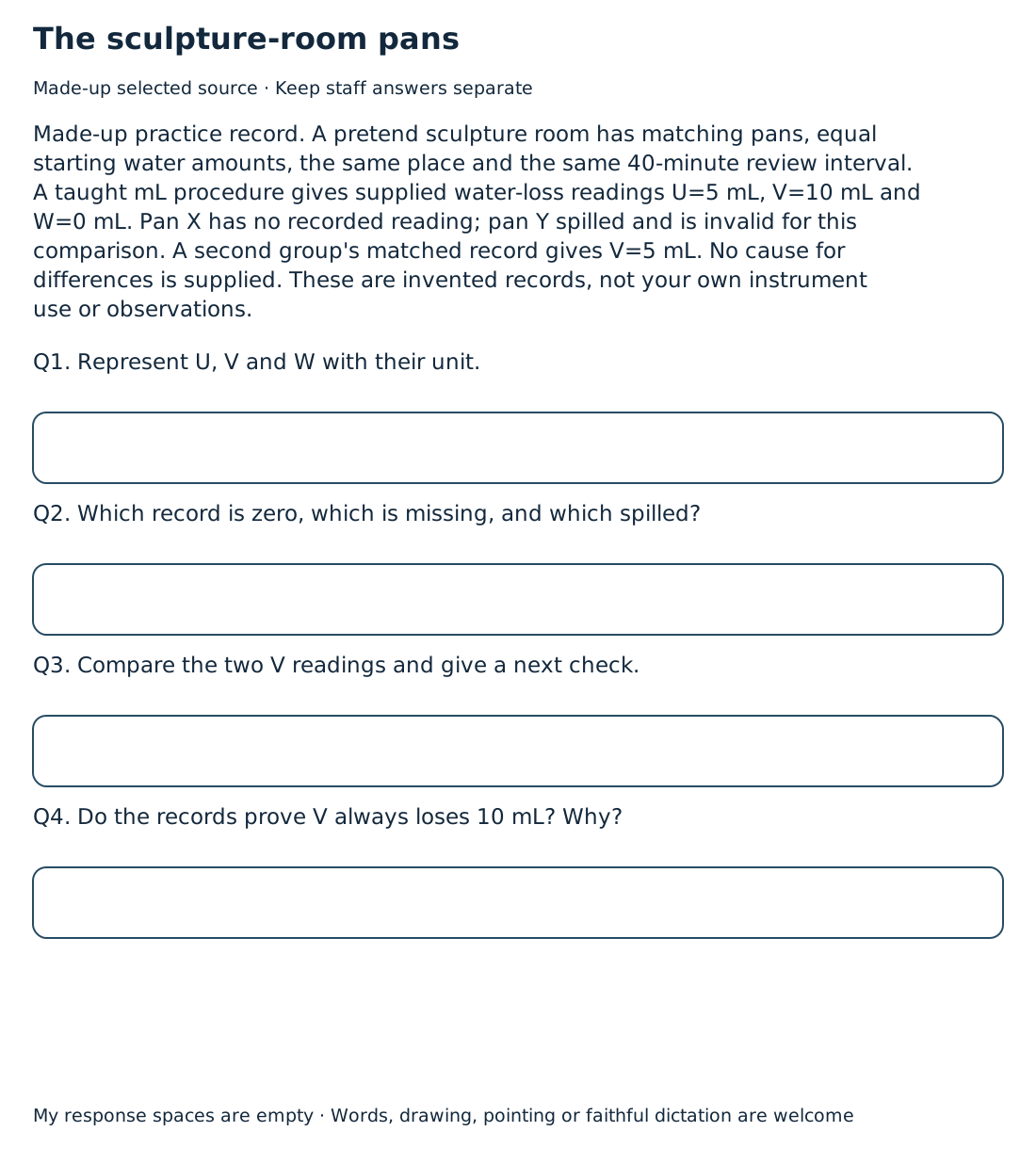
A17 · whole labelled picture · A17 · complete picture words
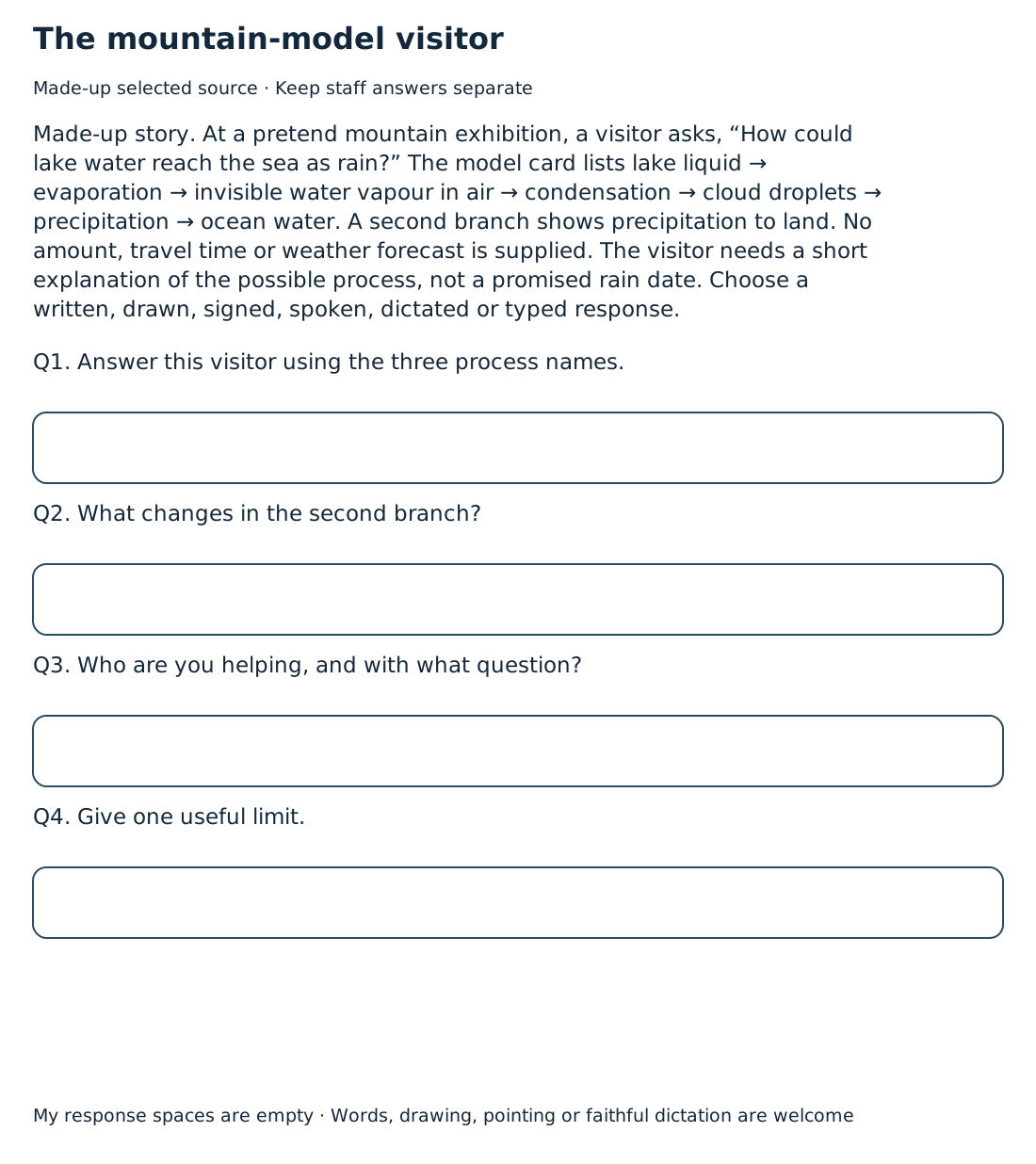
Short child start · Written read-aloud · Water Trail and paper
Partial opportunities: AC9S4U02, AC9S4I05, AC9S4I06 · Full mapping and limits
Grown-up help
Allow source access and neutral reading/support. Keep supplied story, child response, helper actions and actual observation distinct. Use component-specific criteria after the response, not a model answer before it. Suggested six-move timing 4/7/12/8/6/3 minutes may be split; there is no performance timer.
Modified from Year 4 Science alignment, standard elaborations and Years 3–4 techniques and conditions, © State of Queensland (QCAA) 2023, covered CC BY 4.0 with exceptions. Our task criteria are original; these are not official A–E bands. Actual folio and on-balance professional judgment remain necessary.