Start: “Who could your trail help? Choose one question for them.”
Purpose: Create and review a useful audience-specific explanation, using water science accurately and identifying model limits.
Prepare
Read today's complete model and two contexts before the session. Paper, a pencil and the full written picture words are sufficient. Optional actual water work follows ordinary preparation; the teacher chooses suitable familiar materials/instruments. Use today's three routes without assigning a fixed learning-style label.
Run the session
-
Reconnect: choose a question from puddle, outside drops, cloud-to-land rain or tap source. Do not demand the same product from every child.
-
Model: a visitor asks “Will this model tell us when it rains?” Show a useful three-process trail with “This is a model. It does not forecast the weather.” Discuss the actual purpose of an explanation.
-
Try: make a paper guide, labelled drawing, three spoken/dictated lines or interactive Water Trail. Every route includes the chosen audience/question, relevant process/link and a limit.
-
Compare: test the guide on the supplied visitor question; a child can play the visitor quietly or use the text check. Ask what meaning is clear and which arrow needs a name. No forced peer interaction.
-
Make: improve one specific part and keep a short before/after explanation of the revision. Add a second possible path only if it serves the purpose; a longer trail is not automatically better.
-
Exit: “My trail helps __ understand . I changed __ because .” Fresh D is available after this teaching.
Three ways in
Small guide
Make one compact paper/card explanation and ask a supplied visitor question of it. Choose words/drawing/dictation freely.
Worked ordinary reasoning: My guide explains evaporation for someone asking about a smaller puddle; it does not measure an amount.
Interactive path
Choose a valid two-link path in Water Trail, inspect its full text result, change a destination and explain how that serves the chosen question.
Worked ordinary reasoning: Both paper and digital versions are models; neither makes a weather prediction or awards a science grade.
Audio-ready message
Dictate/read a short original explanation with the written script as a full equivalent; recording is optional and not part of assessment.
Worked ordinary reasoning: My message names the process and its direction, answers the chosen question and gives one useful limit.
Look and choose the next teaching
Purposeful accurate explanation, audience/question, sensible revision and source/model limit.
For a beautiful but unclear product, reteach one arrow's meaning before adding decoration.
Today's complete resources
A04 · whole labelled picture · Complete terms · A04 · complete picture words
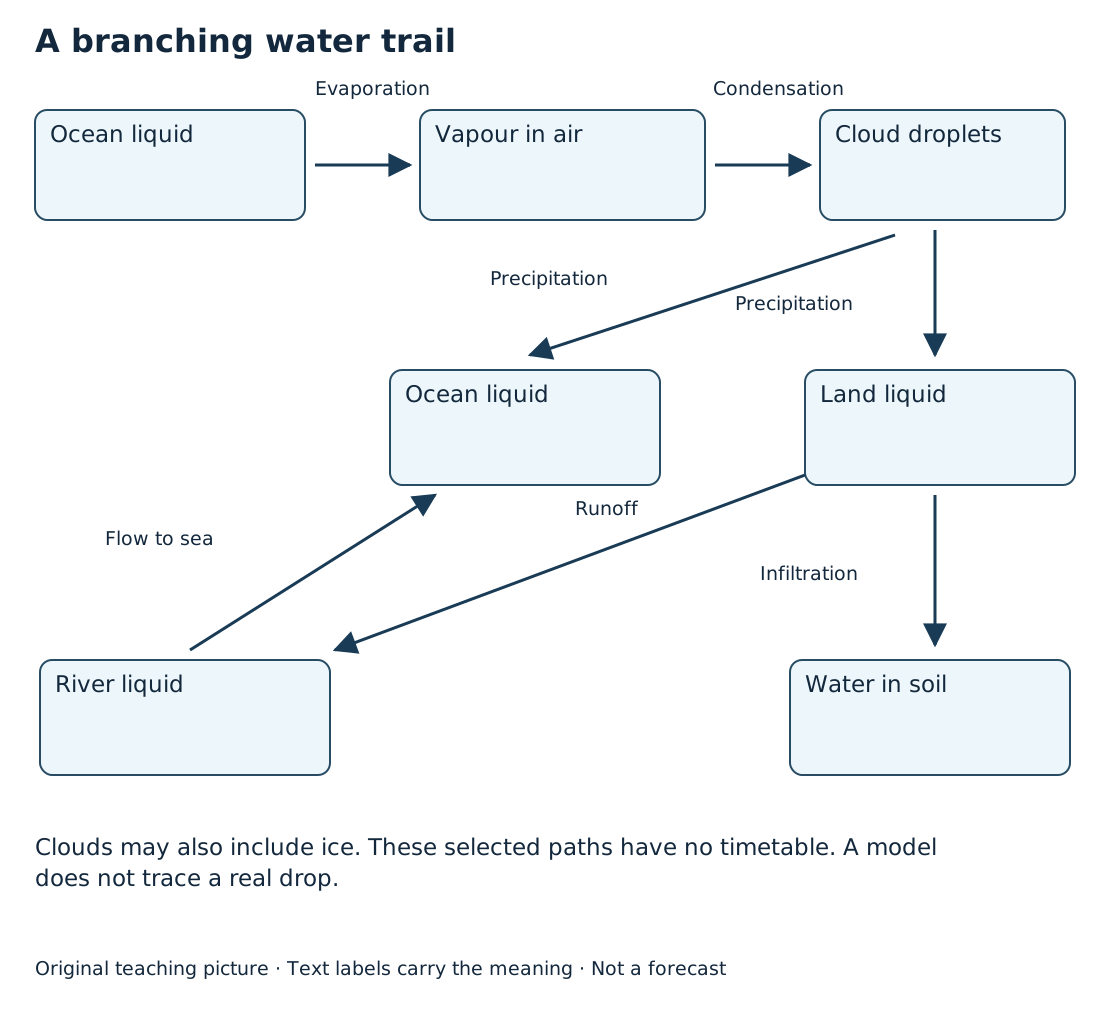
A05 · whole labelled picture · Complete terms · A05 · complete picture words
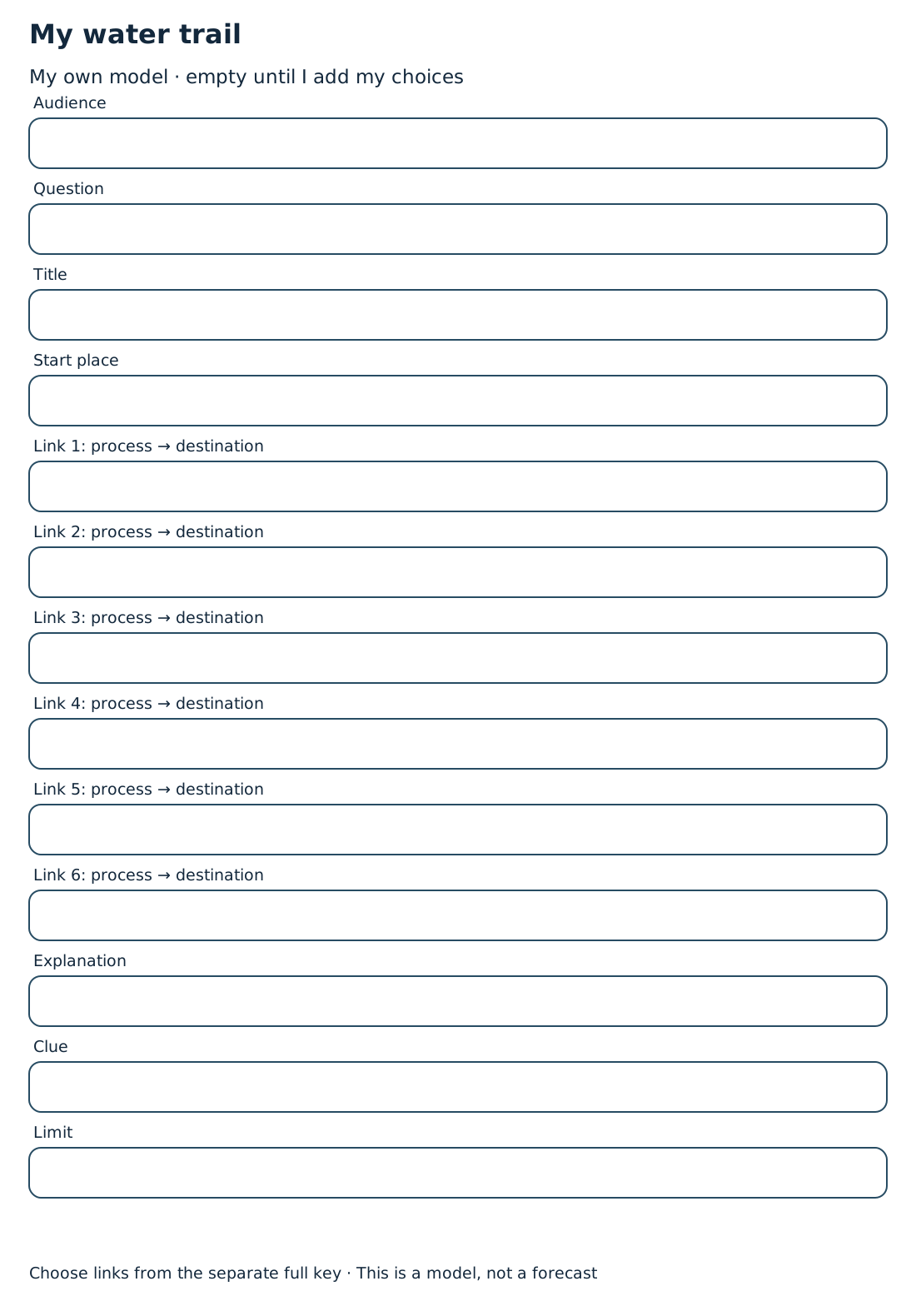
A13 · whole labelled picture · Complete terms · A13 · complete picture words
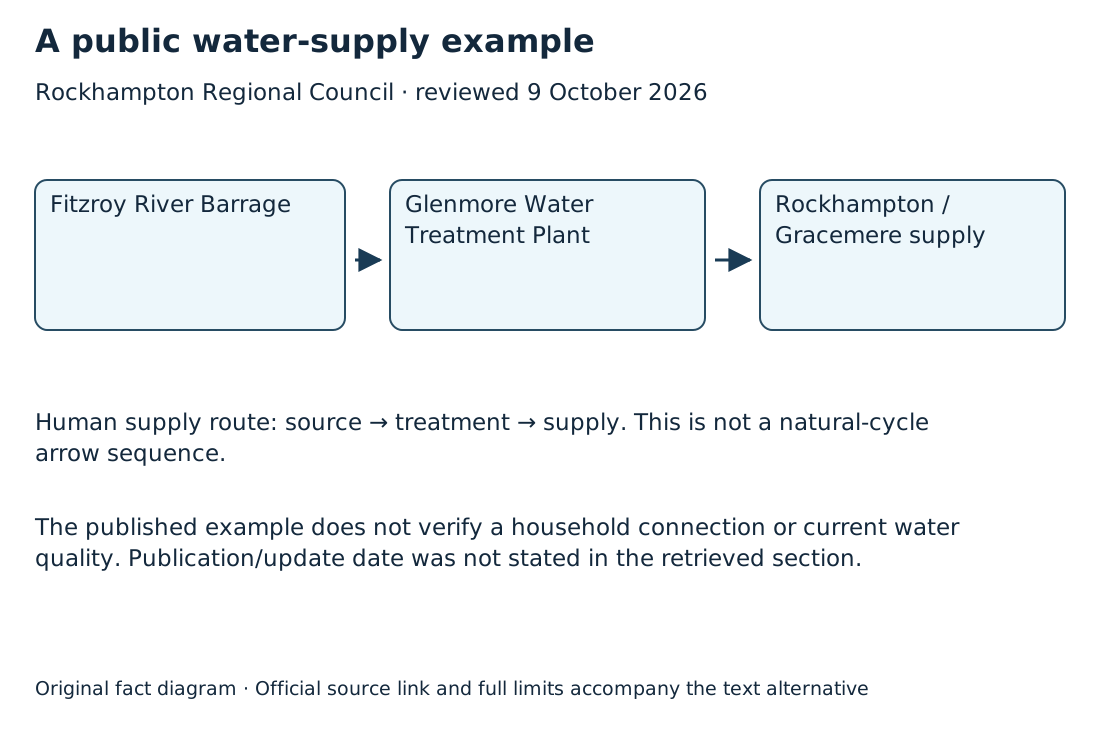
Short child start · Written read-aloud · Water Trail and paper
Partial opportunities: AC9S4U02, AC9S4H02, AC9S4I04, AC9S4I06 · Full mapping and limits