Public educator selection · preserve first work before criteria or later sources. These pages are public; record prior access.
Use this case
Offer the neutral source and four questions after the relevant learning opportunity. Keep staff examples and next teaching on the teacher pages.
Child materials and paper
- B-first · complete neutral source
- B-first · four questions and own response spaces
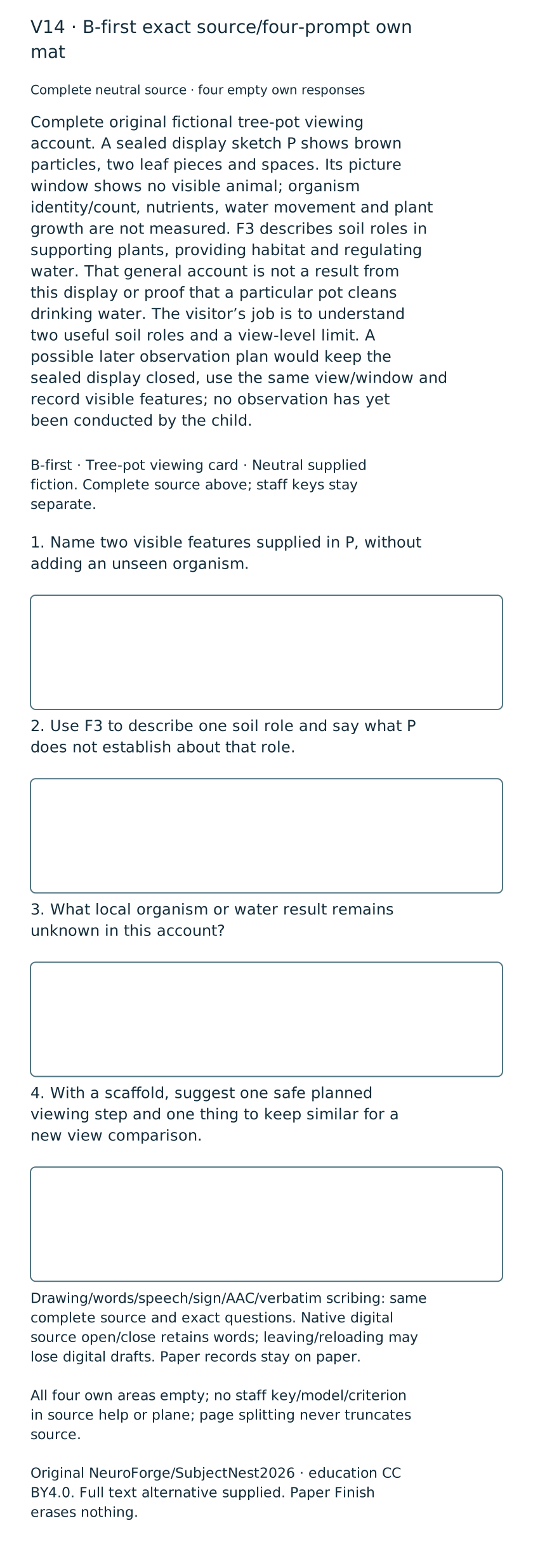
- B-first · complete source and four empty paper questions
- B-first · matching vector mat (V14) · Complete terms
- B-first · full vector text alternative (V14)
After reviewing the child’s own work
Choose the relevant next lesson. These are supported teaching accounts, separate from the child’s case responses.
Complete neutral source
Complete original fictional tree-pot viewing account. A sealed display sketch P shows brown particles, two leaf pieces and spaces. Its picture window shows no visible animal; organism identity/count, nutrients, water movement and plant growth are not measured. F3 describes soil roles in supporting plants, providing habitat and regulating water. That general account is not a result from this display or proof that a particular pot cleans drinking water. The visitor’s job is to understand two useful soil roles and a view-level limit. A possible later observation plan would keep the sealed display closed, use the same view/window and record visible features; no observation has yet been conducted by the child.
Components
Acceptance
Other source-faithful responses in words/drawing/spoken/signed/AAC/exact scribing are legitimate. Apply only this prompt and criterion; no unstated physical action, measured result, word quota or exact model wording. Record actual support and source exposure.
Exact criterion
Two of particles, leaf pieces, spaces from supplied view; no unseen organism/count invented.
Exact prompt
Name two visible features supplied in P, without adding an unseen organism.
Full unrelated next lesson
Child invitation
Give two actual supplied view features for the shop-window reader.
Four teacher moves
- Read the entire new source with its names, times, conditions and unknowns. Ask one initial meaning question before showing the staff possibility. Let the child ask to hear the whole source again or pass.
- Model selecting two visible features and marking the concealed area unknown, avoiding a story invented behind the panel.
- Read the complete different guided account below. Guide one heading or source location, then pause for the child to make their own distinction. Keep the original worked example separate; no model sentence is inserted into their own work.
- Invite the exact child job below. Record the observable distinction, actual source, mode, support and any unperformed work. Give feedback about one chosen clue, then decide whether another unrelated new opportunity is useful.
Guided different complete source
Different fictional shop-window drawing shows a round clock and a shelf with three paper outlines; the lower cupboard is closed. Invite two visible features without adding hidden stock.
Id
N05
Mode limit
These are supported teaching opportunities after component review. Reasoning from a supplied account, a model and actual child conduct are different evidence. A helper operation is attributed; declining, length or format is not an ability diagnosis or grade.
Next decision
If this distinction is still unclear, return to one source-labelled heading pair in this new account and one question. If clear, offer a genuinely fresh ordinary job after further learning. Do not rehearse the held key and call its repetition untouched first/later evidence.
Observable evidence
Child names supplied visible features and does not populate an unseen area from imagination.
Ordinary staff possible model
The sign and seats are supplied visible features; the hidden area gives no passenger count.
Teacher preparation
Read the complete new source and different guided account below; prepare large paper headings and a genuinely empty own response area. The accounts are original supplied fiction, not a verified local event. Offer spoken/signed/AAC, pointing with confirmed read-back, drawing or verbatim scribing. No specialised equipment, media recording, purchases or public sharing is needed.
Title
Transport-display visible features
Whole unrelated source
Fictional bus-stop model drawing shows a rectangular sign, two seats and an empty area behind a panel. No people or hidden timetable are visible.
Id
B-first-1
Initial own value
One staff possible response
The supplied sketch shows particles and two leaf pieces; it gives no visible animal.
Acceptance
Other source-faithful responses in words/drawing/spoken/signed/AAC/exact scribing are legitimate. Apply only this prompt and criterion; no unstated physical action, measured result, word quota or exact model wording. Record actual support and source exposure.
Exact criterion
One accurate F3 role with corresponding specimen-level organism/water/growth unknown. General habitat role not disproved by no visible animal.
Exact prompt
Use F3 to describe one soil role and say what P does not establish about that role.
Full unrelated next lesson
Child invitation
Help the theatre reader name a role and a view-level limit.
Four teacher moves
- Read the entire new source with its names, times, conditions and unknowns. Ask one initial meaning question before showing the staff possibility. Let the child ask to hear the whole source again or pass.
- Model Source role versus Particular evidence and explain why a closed view is not proof that the role is impossible.
- Read the complete different guided account below. Guide one heading or source location, then pause for the child to make their own distinction. Keep the original worked example separate; no model sentence is inserted into their own work.
- Invite the exact child job below. Record the observable distinction, actual source, mode, support and any unperformed work. Give feedback about one chosen clue, then decide whether another unrelated new opportunity is useful.
Guided different complete source
Different fictional theatre reference says stages can host performances; its empty stage drawing has no performance record. Ask for the source role and what this particular view does not establish.
Id
N06
Mode limit
These are supported teaching opportunities after component review. Reasoning from a supplied account, a model and actual child conduct are different evidence. A helper operation is attributed; declining, length or format is not an ability diagnosis or grade.
Next decision
If this distinction is still unclear, return to one source-labelled heading pair in this new account and one question. If clear, offer a genuinely fresh ordinary job after further learning. Do not rehearse the held key and call its repetition untouched first/later evidence.
Observable evidence
Child separates a general source role from an unsupported particular outcome or contents claim.
Ordinary staff possible model
The source supplies a general storage role; this closed drawing does not show its actual contents.
Teacher preparation
Read the complete new source and different guided account below; prepare large paper headings and a genuinely empty own response area. The accounts are original supplied fiction, not a verified local event. Offer spoken/signed/AAC, pointing with confirmed read-back, drawing or verbatim scribing. No specialised equipment, media recording, purchases or public sharing is needed.
Title
General storage role and particular cupboard
Whole unrelated source
Fictional information card says this story’s cupboards can store drawing supplies. A particular closed cupboard drawing gives no contents. The artist wants a useful label.
Id
B-first-2
Initial own value
One staff possible response
F3 describes habitat; P does not establish which organisms live in this pot.
Acceptance
Other source-faithful responses in words/drawing/spoken/signed/AAC/exact scribing are legitimate. Apply only this prompt and criterion; no unstated physical action, measured result, word quota or exact model wording. Record actual support and source exposure.
Exact criterion
One stated local organism identity/count or water movement/safety result unknown; no claim of no habitat or safe water.
Exact prompt
What local organism or water result remains unknown in this account?
Full unrelated next lesson
Child invitation
Mark one detail the library parcel account does not supply.
Four teacher moves
- Read the entire new source with its names, times, conditions and unknowns. Ask one initial meaning question before showing the staff possibility. Let the child ask to hear the whole source again or pass.
- Model the known count separately from missing details; explain missing is neither zero nor a guessed place.
- Read the complete different guided account below. Guide one heading or source location, then pause for the child to make their own distinction. Keep the original worked example separate; no model sentence is inserted into their own work.
- Invite the exact child job below. Record the observable distinction, actual source, mode, support and any unperformed work. Give feedback about one chosen clue, then decide whether another unrelated new opportunity is useful.
Guided different complete source
Different fictional library parcel record gives one package but no contents or departure town. Invite a supported known fact and one genuinely missing detail for a reader.
Id
N07
Mode limit
These are supported teaching opportunities after component review. Reasoning from a supplied account, a model and actual child conduct are different evidence. A helper operation is attributed; declining, length or format is not an ability diagnosis or grade.
Next decision
If this distinction is still unclear, return to one source-labelled heading pair in this new account and one question. If clear, offer a genuinely fresh ordinary job after further learning. Do not rehearse the held key and call its repetition untouched first/later evidence.
Observable evidence
Child recognises a source-specific missing detail without filling it by guess or treating missing as none.
Ordinary staff possible model
The count is supplied; maker location and material remain unknown.
Teacher preparation
Read the complete new source and different guided account below; prepare large paper headings and a genuinely empty own response area. The accounts are original supplied fiction, not a verified local event. Offer spoken/signed/AAC, pointing with confirmed read-back, drawing or verbatim scribing. No specialised equipment, media recording, purchases or public sharing is needed.
Title
Museum record with missing details
Whole unrelated source
Fictional museum crate record says three display cards arrived but gives no material label or sender location. A visitor asks where the cards were made.
Id
B-first-3
Initial own value
One staff possible response
No organism identity/count or local water movement result is supplied.
Acceptance
Other source-faithful responses in words/drawing/spoken/signed/AAC/exact scribing are legitimate. Apply only this prompt and criterion; no unstated physical action, measured result, word quota or exact model wording. Record actual support and source exposure.
Exact criterion
One relevant sealed/safe viewing-record step and one relevant same window/view condition; plan only, no actual conduct required.
Exact prompt
With a scaffold, suggest one safe planned viewing step and one thing to keep similar for a new view comparison.
Full unrelated next lesson
Child invitation
Plan one paper-viewing step and a relevant similarity for the postcard job.
Four teacher moves
- Read the entire new source with its names, times, conditions and unknowns. Ask one initial meaning question before showing the staff possibility. Let the child ask to hear the whole source again or pass.
- Use the supplied scaffold Question, Step, Similarity, Stop and label every entry as proposed rather than performed.
- Read the complete different guided account below. Guide one heading or source location, then pause for the child to make their own distinction. Keep the original worked example separate; no model sentence is inserted into their own work.
- Invite the exact child job below. Record the observable distinction, actual source, mode, support and any unperformed work. Give feedback about one chosen clue, then decide whether another unrelated new opportunity is useful.
Guided different complete source
Different fictional postcard plan asks about border width on a paper display. Keep card size and viewing spot similar, change only the border and use a clear desk; no effect on readers is supplied. Invite one safe proposed step and one similarity.
Id
N08
Mode limit
These are supported teaching opportunities after component review. Reasoning from a supplied account, a model and actual child conduct are different evidence. A helper operation is attributed; declining, length or format is not an ability diagnosis or grade.
Next decision
If this distinction is still unclear, return to one source-labelled heading pair in this new account and one question. If clear, offer a genuinely fresh ordinary job after further learning. Do not rehearse the held key and call its repetition untouched first/later evidence.
Observable evidence
Child proposes a relevant safe step and matching condition without claiming an investigation already happened.
Ordinary staff possible model
For the proposed comparison, change title-letter size and keep layout/view distance similar; no reader outcome is yet known.
Teacher preparation
Read the complete new source and different guided account below; prepare large paper headings and a genuinely empty own response area. The accounts are original supplied fiction, not a verified local event. Offer spoken/signed/AAC, pointing with confirmed read-back, drawing or verbatim scribing. No specialised equipment, media recording, purchases or public sharing is needed.
Title
Noticeboard comparison plan
Whole unrelated source
Fictional noticeboard plan asks whether larger title letters help locate a heading. Two same-size paper layouts are available; no reader trial exists. The safe plan uses paper on a clear desk.
Id
B-first-4
Initial own value
One staff possible response
Keep the display closed, record visible features through the same window; keep the viewing area similar.
Eligibility
Offer only after relevant actual teaching opportunity; first capture/decline precedes its corresponding later source and all staff keys. Record source familiarity, earlier answer exposure, child/adult operations, wording help, mode, actual versus supplied/model evidence and time/order. Coached reuse is teaching, not untouched evidence.
Exact four prompts
- Name two visible features supplied in P, without adding an unseen organism.
- Use F3 to describe one soil role and say what P does not establish about that role.
- What local organism or water result remains unknown in this account?
- With a scaffold, suggest one safe planned viewing step and one thing to keep similar for a new view comparison.
Id
B-first
Learner door
Native initially closed same-page complete neutral source disclosure, four exact matching prompts and genuinely empty own spaces. Open/close retains drafts without JS. External full-source reference remains optional; leave/reload may discard memory-only words. Exact paper mat repeats the source identity, whole source and four empty prompts; no criteria/models/next teaching in help.
Own values
Source kind
Original supplied fiction; provider knowledge is separately attributed. No actual child/local trial or reader success supplied.
Title
Tree-pot viewing card
About this resource
Reviewed source editionSource review is complete for this two-week edition. Local suitability and classroom use still need review. Earlier candidate or pending-review words are retained in the original files; full-year coverage, translations and audio are not claimed.
Labels and search exclusions are distribution guidance; they do not authenticate or restrict access.
Exact source: 089d6ac9ec4293ea4b949980b0e79e5cbf08fc82 · 2026-10-13. Source edition, roles and hashes
Complete source and rights notices
Keep these full notices with copies of this resource. Learning text, software, art and outside sources keep their own terms.