Use this case
Offer the neutral source and four questions after the relevant learning opportunity. Keep staff examples and next teaching on the teacher pages.
Child materials and paper
- B-later · complete neutral source
- B-later · four questions and own response spaces
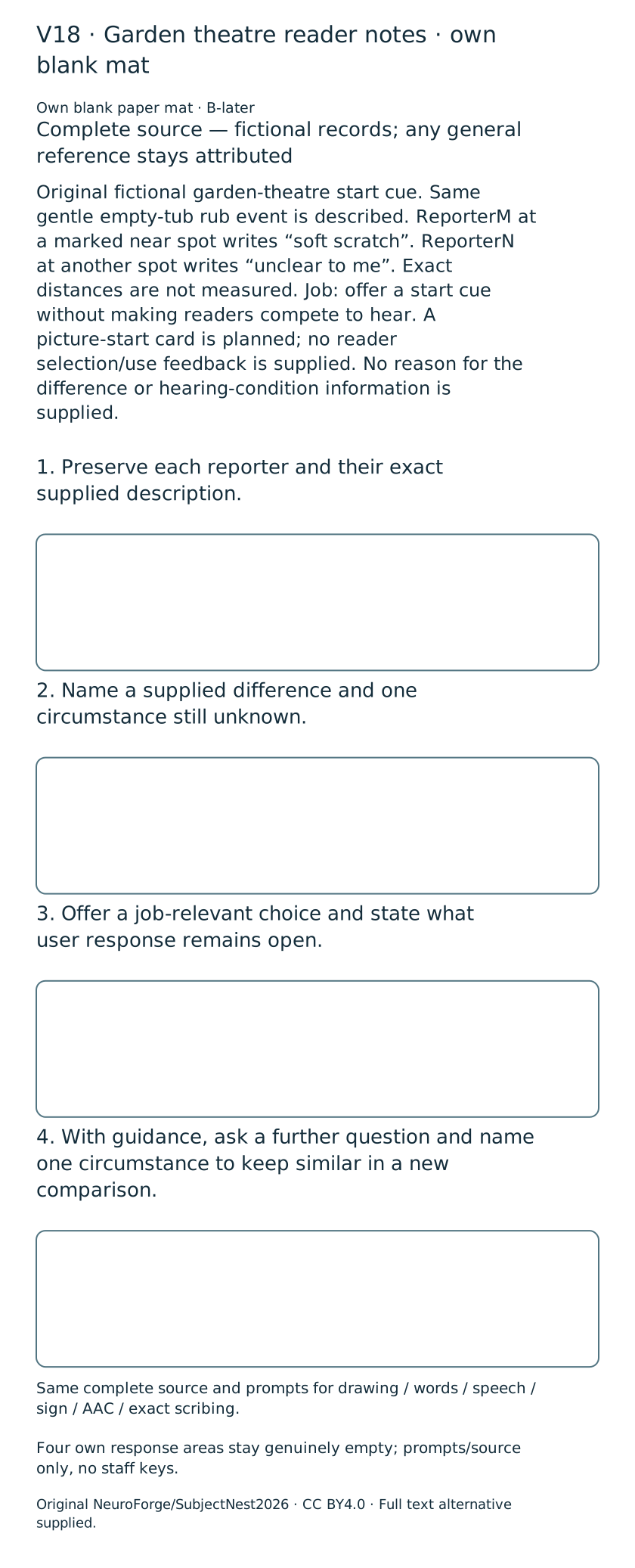
- B-later · matching four-question paper mat (V18)
- B-later · full paper-mat text alternative (V18)
After reviewing the child’s own work
Choose the relevant next lesson. These are supported teaching accounts, separate from the child’s case responses.
Complete neutral source
Original fictional garden-theatre start cue. Same gentle empty-tub rub event is described. ReporterM at a marked near spot writes “soft scratch”. ReporterN at another spot writes “unclear to me”. Exact distances are not measured. Job: offer a start cue without making readers compete to hear. A picture-start card is planned; no reader selection/use feedback is supplied. No reason for the difference or hearing-condition information is supplied.
Components
Accept other responses
Accept a different source-faithful response in text/drawing/speech/sign/AAC/exact scribing. No required wording, hearing performance or neatness score. Apply only the exact prompt/criterion; no unstated physical action or result required.
Exact component criterion
KeepsM soft scratch/N unclear to me attributed separately.
Exact prompt
Preserve each reporter and their exact supplied description.
Full individual next learning
Child invitation
Write two separate reports without inventing a reason for the difference.
Guided different context
New pretend bookmark reports readerX “clear word”, readerY “not sure”; no reading test supplied.
Id
N21
Mode opportunity
This is supported teaching after review. Actual performing, reasoning about supplied stories and model construction are recorded separately. New-context transfer is a small observed step, not annual mastery or a new official grade.
Next decision
If the named distinction is still unclear, return to two source-labelled cards in this unrelated context and one prompt at a time. If clear, offer a different job/source after further learning; do not retry this held case with the staff model rehearsed.
Observable next evidence
Child preserves exact report ownership and avoids ability judgements.
Ordinary possible model
Keep both attributed descriptions and known limits.
Teacher preparation
Full account/model and a separate blank child page; cards or paper drawings as named in the guided context. Offer pointing/AAC/exact scribing and quiet helper operation. No source collection or public publication is required.
Teacher sequence
- Read the complete new account and ask which event/reference is actually supplied before showing its ordinary model.
- Model attribution with badge cards; guide one bookmark report pairing, then child dictates the second and a question about circumstances.
- Guide the different new context above using an open question. After child chooses, pause so they can author/select/draw their own evidence distinction; the model answer stays a teaching example, never inserted into their own work.
- Invite the child to explain one exact clue and one limit in the new task. Keep actual events, supplied stories and unperformed plans labelled. Use the observable check below to choose whether to revisit this meaning or offer a genuinely fresh task later.
Title
Craft-feedback attribution
Whole unrelated teaching account
A fictional badge note has makerP say “easy to hold” and makerQ say “not sure”; conditions are absent.
Id
B-later-1
Initial own value
One possible staff response
M: soft scratch. N: unclear to me.
Staff focus
I03/I06 attributed reports
Accept other responses
Accept a different source-faithful response in text/drawing/speech/sign/AAC/exact scribing. No required wording, hearing performance or neatness score. Apply only the exact prompt/criterion; no unstated physical action or result required.
Exact component criterion
Reports different descriptions with unmeasured distance or unknown reason identified; no diagnosis/ranking.
Exact prompt
Name a supplied difference and one circumstance still unknown.
Full individual next learning
Child invitation
Sort known and unknown circumstances and ask for one useful missing detail.
Guided different context
Use a new pretend gallery record giving shelf position but not viewing height.
Id
N22
Mode opportunity
This is supported teaching after review. Actual performing, reasoning about supplied stories and model construction are recorded separately. New-context transfer is a small observed step, not annual mastery or a new official grade.
Next decision
If the named distinction is still unclear, return to two source-labelled cards in this unrelated context and one prompt at a time. If clear, offer a different job/source after further learning; do not retry this held case with the staff model rehearsed.
Observable next evidence
Child names an actual supplied circumstance and an unresolved one accurately.
Ordinary possible model
Gate is supplied; lighting and sign distance remain unknown.
Teacher preparation
Full account/model and a separate blank child page; cards or paper drawings as named in the guided context. Offer pointing/AAC/exact scribing and quiet helper operation. No source collection or public publication is required.
Teacher sequence
- Read the complete new account and ask which event/reference is actually supplied before showing its ordinary model.
- Read full map record, guide gallery position/height lanes and invite a new question, not an assumed cause of a reader report.
- Guide the different new context above using an open question. After child chooses, pause so they can author/select/draw their own evidence distinction; the model answer stays a teaching example, never inserted into their own work.
- Invite the child to explain one exact clue and one limit in the new task. Keep actual events, supplied stories and unperformed plans labelled. Use the observable check below to choose whether to revisit this meaning or offer a genuinely fresh task later.
Title
Playground-map circumstances
Whole unrelated teaching account
A fictional map report says visitor stood at gate, but no lighting or distance-to-sign information exists.
Id
B-later-2
Initial own value
One possible staff response
Reports differ; exact distances are not measured and whyN found it unclear is unknown.
Staff focus
I05 bounded difference
Accept other responses
Accept a different source-faithful response in text/drawing/speech/sign/AAC/exact scribing. No required wording, hearing performance or neatness score. Apply only the exact prompt/criterion; no unstated physical action or result required.
Exact component criterion
Relevant cue options preserve absent actual reader selection/use; no guaranteed accessibility claim.
Exact prompt
Offer a job-relevant choice and state what user response remains open.
Full individual next learning
Child invitation
Offer a job-relevant choice without claiming every reader can use it.
Guided different context
Create a new pretend pottery queue card offering picture turn or written word turn, with a helper’s voluntary selection.
Id
N23
Mode opportunity
This is supported teaching after review. Actual performing, reasoning about supplied stories and model construction are recorded separately. New-context transfer is a small observed step, not annual mastery or a new official grade.
Next decision
If the named distinction is still unclear, return to two source-labelled cards in this unrelated context and one prompt at a time. If clear, offer a different job/source after further learning; do not retry this held case with the staff model rehearsed.
Observable next evidence
Child gives an inclusive bounded choice and respects refusal.
Ordinary possible model
A silent arrow fits the stated quiet purpose; effectiveness is untested.
Teacher preparation
Full account/model and a separate blank child page; cards or paper drawings as named in the guided context. Offer pointing/AAC/exact scribing and quiet helper operation. No source collection or public publication is required.
Teacher sequence
- Read the complete new account and ask which event/reference is actually supplied before showing its ordinary model.
- Model purpose/choice/gap from chess; rehearse pottery invitation, then child lets helper choose or pass and records only actual feedback.
- Guide the different new context above using an open question. After child chooses, pause so they can author/select/draw their own evidence distinction; the model answer stays a teaching example, never inserted into their own work.
- Invite the child to explain one exact clue and one limit in the new task. Keep actual events, supplied stories and unperformed plans labelled. Use the observable check below to choose whether to revisit this meaning or offer a genuinely fresh task later.
Title
Quiet chess-turn choice
Whole unrelated teaching account
A fictional chess club wants turns shown silently; paper arrow cue is planned, no player trial occurred.
Id
B-later-3
Initial own value
One possible staff response
I would offer a picture-start card and an optional gentle cue; no reader’s selection/use is recorded.
Staff focus
H01 purpose/reader choice
Accept other responses
Accept a different source-faithful response in text/drawing/speech/sign/AAC/exact scribing. No required wording, hearing performance or neatness score. Apply only the exact prompt/criterion; no unstated physical action or result required.
Exact component criterion
Purpose-linked question plus planned similar circumstance; guidance allowed and result open.
Exact prompt
With guidance, ask a further question and name one circumstance to keep similar in a new comparison.
Full individual next learning
Child invitation
Ask what to investigate next and say one condition to keep similar.
Guided different context
Plan a new desk-organiser comparison changing one divider drawing while keeping same ticket drawings and tray.
Id
N24
Mode opportunity
This is supported teaching after review. Actual performing, reasoning about supplied stories and model construction are recorded separately. New-context transfer is a small observed step, not annual mastery or a new official grade.
Next decision
If the named distinction is still unclear, return to two source-labelled cards in this unrelated context and one prompt at a time. If clear, offer a different job/source after further learning; do not retry this held case with the staff model rehearsed.
Observable next evidence
Child asks a useful guided comparison question rather than repeating an unsupported conclusion.
Ordinary possible model
Two changes limit a padding-only conclusion.
Teacher preparation
Full account/model and a separate blank child page; cards or paper drawings as named in the guided context. Offer pointing/AAC/exact scribing and quiet helper operation. No source collection or public publication is required.
Teacher sequence
- Read the complete new account and ask which event/reference is actually supplied before showing its ordinary model.
- Show full packing record; guide organiser question/change relation, then child proposes a next enquiry with result left open.
- Guide the different new context above using an open question. After child chooses, pause so they can author/select/draw their own evidence distinction; the model answer stays a teaching example, never inserted into their own work.
- Invite the child to explain one exact clue and one limit in the new task. Keep actual events, supplied stories and unperformed plans labelled. Use the observable check below to choose whether to revisit this meaning or offer a genuinely fresh task later.
Title
Packing-test question
Whole unrelated teaching account
A fictional packing record changed both box and padding when checking two paper tickets; no drop test is permitted.
Id
B-later-4
Initial own value
One possible staff response
Which start cue would a willing reader choose? For a new event comparison keep the observer spot similar and note it.
Staff focus
I01/I05 future question/similarity
Delivery
Read/display the exact whole neutral source and prompts, with one question at a time if wanted. Do not read criteria/worked/next accounts. Each own page has initial-closed same-page full neutral source disclosure and an external whole-source link; paper mat repeats this source identity and four exact prompts.
Eligibility
Staff records learning opportunity, familiarity with source, prior answer exposure, adult help/operation/scribing, mode, self-directed versus guided reasoning and whether actual practical evidence was offered. After coaching on this source, use it as teaching and arrange genuinely fresh later evidence.
Exact four prompts
- Preserve each reporter and their exact supplied description.
- Name a supplied difference and one circumstance still unknown.
- Offer a job-relevant choice and state what user response remains open.
- With guidance, ask a further question and name one circumstance to keep similar in a new comparison.
First later
First and later are eligible local evidence opportunities, not required timing or a numerical progress scale. Describing supplied outcomes does not demonstrate practical conducting; keep actual observations in a separate folio.
Id
B-later
Own response values
Role
neutral held assessment source; teacher offered only after relevant learning opportunity; independent staff criterion/models separate
Source kind
original supplied fiction; any reference fact/model explicitly labelled
Title
Garden theatre reader notes