Creator: SubjectNest by NeuroForgeIO Pty Ltd with Codex assistance. Saved 1 October 2026. Original written fiction, descriptive informative text and digital illustration; CC BY 4.0. Purpose: compare the language/organisation of narrative and information and invite child-owned composition. No human author interview, community importance, actual child game or audience response is claimed. These sources do not sample the range of Australian/world/First Nations authors.
Drawing J · Paper harbour
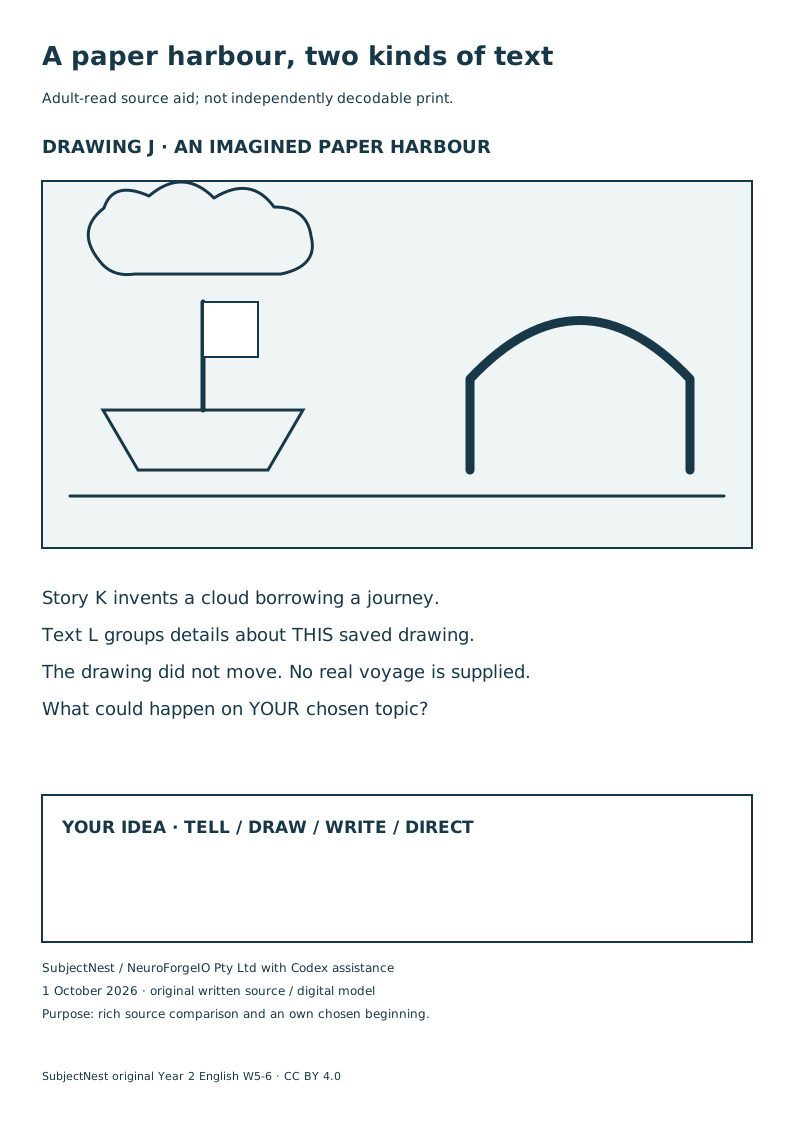
Actual supplied file: harbour-scene.svg, also PDF. Original drawn model, not a photograph or actual harbour/craft. In its upper scene panel, a long boat is at the left. Its single tall mast carries one square flag. A cloud outline is above the boat. A broad arched bridge is at the right. A long horizontal line below represents the imagined water edge. There are no people, arrows, completion ticks or actual movement results. An empty own-idea field below is not part of the described harbour scene. Colours are production choices; none is a required source fact.
Story K · The cloud that borrowed a boat
Mira had drawn a harbour on a large sheet. A long boat waited below a cloud, and a broad bridge curved over the far side of the page. Dev wanted to tell a story about the boat. Mira wanted to tell a story about the cloud.
“Why must one of them wait?” Dev asked. He wrote a small speech bubble beside the cloud: “May I borrow your boat?”
Mira looked at the enormous cloud and the little boat. “You will spill over both sides,” she said in the boat's very serious voice.
“I could be a thin mist,” Dev answered for the cloud.
The cloud curled into a pale ribbon in their imagined story. The boat sailed beneath the bridge, but the mist stayed just above its mast. At the other side, the mist spread wide again.
Mira laughed. “It borrowed a journey, not a seat.” She added that sentence under the drawing.
Dev suggested another ending: perhaps the boat could visit the cloud instead. They left that ending unwritten. Their drawing did not move. The voyage happened in the story they invented together.
Exact limits: all characters, voices and voyage are fiction. The saved Drawing J does not show the story's mist, speech bubble or voyage. “Very serious” is the fictional boat voice chosen by the writer, not a required child voice/emotion. The proposed other ending was unmade in the fiction; neither ending is an actual played result.
Text L · Inside Drawing J: a paper harbour
What this page describes
This page describes the saved illustration called Drawing J. It can help a reader find its parts. The drawing is an imagined harbour, not a photograph of a real place.
Boat and flag
A long boat is on the left of the scene. One tall mast rises from the boat. A square flag is attached near the top of that mast. The scene does not show a person steering the boat.
Cloud and bridge
A cloud outline is above the boat. A broad arched bridge is on the right. A horizontal line runs below these parts. It represents an imagined water edge; it is not a recorded water level.
What the page cannot tell us
The drawing does not show a completed voyage or a paper object being tested. It cannot tell us that a real boat floats or that real weather changed. Story K invents events using this topic. This page instead groups statements under headings so a reader can locate drawing details. Your own information text can use a heading or another clear grouping; no copied layout is required.
Short portions, not a long daily lecture
Day 21: Story K first two paragraphs after own idea. Day 22: remaining story then Text L first section; finish Text L on Day 26. Day 23: reread cloud/boat dialogue and final three paragraphs. Day 24: two story sentences only. Day 25: no new ordinary source facts during held turn. Day 26: Text L in sections with a child question between. Day 27: word-family examples, not another full read. Day 28: one chosen relevant paragraph of either source. Day 29: the child's own actual text first. Day 30: new held source only; ordinary enrichment follows first capture.
The whole rich texts remain available for rereading in an available form. Adult reading is listening/attributed access, not independent decoding. Child curiosity can redirect which short portion is useful. Topic vocabulary: harbour, mast, arch, mist, voyage, attached, represents; choose a useful word, explain in context, and welcome a plainer wording. No vocabulary quota or science/weather inference from fiction.