Day 44 · A sentence can tell a complete ideaYear 1 English · T1 W9–10 · Child / Day 44
Source review complete · local suitability still needs review.
Compose a complete informative state/event sentence and reread its boundary.
- Choose one small topic or source detail.
- Tell, write, type or direct one useful idea.
- Read it back, or ask for readback. Keep, change a bit or finish.
Example to hear: The map and cap are inside the bag.
Pick a way in
Create a factual sentence about the supplied bag drawing, then choose one boundary mark.
Explain one suitable object at an imaginary help desk: who/what plus what you know. Use paper/type/own directed words.
Compose in sign/AAC/spoken language, then optionally direct exact written words and boundary. Offer no-physical-writing completion for the meaning goal; handwriting remains separately open.
Open your empty report page · Complete terms · Pictures and full descriptions
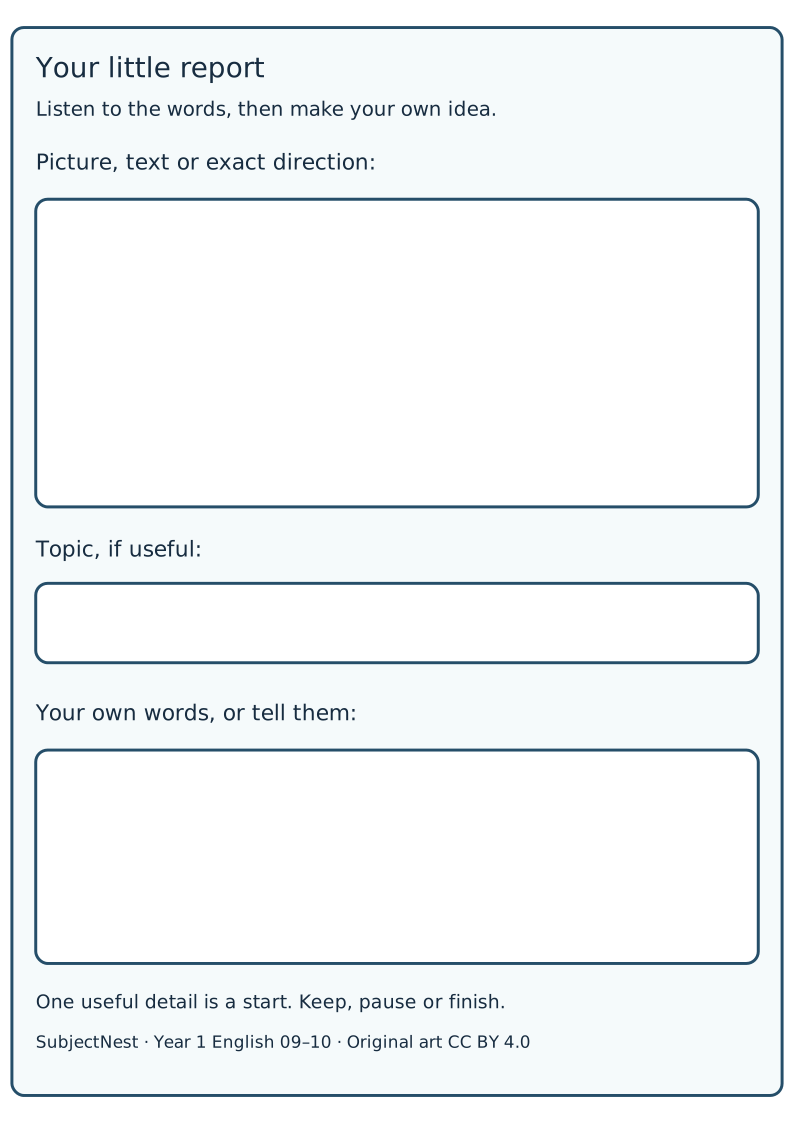
These boxes do not save or send. Keep a copy yourself if wanted. You can tell it without using a box.
Grown-up help
Choose one short sitting; about 25–30 minutes is an author planning estimate, not a required dose or tested timing. Keep/pause/finish and a return later are valid. No purchase, outing, upload, account, private disclosure, recording, forced speech/eye-contact/movement or audience. Use established communication, sign/AAC, suitable enlarged print, keyboard or exact child-directed scribing as appropriate. Ask before touching/moving belongings; do not require handling real objects. Read rich text aloud or provide agreed exact text access: it is not automatic independent reading. No-print listening/composition alternatives keep meaning useful, but do not prove decoding. Adults record their own reading, phoneme cues, grapheme supply, spelling and physical marking separately. An actual oral report is oral; a picture+language text has actual stated components; an unwritten proposal is a plan. A scribe can preserve child composition while adult spelling/handwriting remains adult. Only observe handwriting when the child actually forms letters. Only record real interaction when a willing other person actually participates. Do not infer a listener reply from a paper figure, adult model or intended reader.
Today: Child makes one complete sentence about their own chosen drawing/object/topic, chooses a capital and boundary with appropriate support, rereads or receives exact readback.
Observe: Notice completeness, relevant detail, punctuation and actual spelling/letter formation as separate components. A typed or scribed sentence can show composition but not independent handwriting.
Next teaching: If the sentence is a fragment, respond with one natural question about the missing idea rather than a rigid three-word frame. If punctuation is missing, read two complete ideas and help locate one boundary.
Each ordinary day: select one locally eligible cumulative passage and two or three locally eligible words; no automatic new grapheme in this bank. Say a chosen word normally, then model its full ordered phonemes using the reviewed map. Digraph sh/ch/optional final ck represents one phoneme; s+t and n+d stay separate sounds. Let child blend the print, reread a phrase naturally, then give the meaning. If the first reading attempt is needed, capture it before modelling. For writing, say the separate chosen dictation word normally; learner segments, selects graphemes and writes/types/arranges them if suitable. Teacher can model and invite another attempt after capture; mark supplied graphemes separately. Handwriting: offer one locally taught unjoined letter from the word, modelling that school's letter formation and inviting an actual comfortable attempt; exact formation needs local judgement and is not provided by a system font. Familiar a/is require explicit actual teaching as described in the lexicon. Meaning context confirms reading; do not replace grapheme blending by picture guessing. Oral sound manipulation is separate from printed new-code teaching. If no passage fits, keep rich listening/composition and explicitly teach one earlier taught correspondence with a locally matched word; not-yet-offered print is not failed reading. Long vowels, two-syllable patterns, wider high-frequency words and morphemes need separate actual school teaching; this bank does not claim to complete them.
Complete teacher plan · Print eligibility and full maps · Separate teacher checks and keys
About this resource
Reviewed source editionSource review is complete for this two-week edition. Local suitability and classroom use still need review. Earlier candidate or pending-review words are retained in the original files; full-year coverage, translations and audio are not claimed.
Exact source: 806988e90cafc035a42d6b870c9587d314becdee · 2026-10-08. Source edition, roles and hashes
Complete source and licence companions
Keep these complete conditions with PDF, SVG, text and ZIP copies. PDFs use the complete separate source and licence companions below; the downloadable packets keep their declared companions.