A maker explains a start cue
A make-believe story. A helper can read it one part at a time.
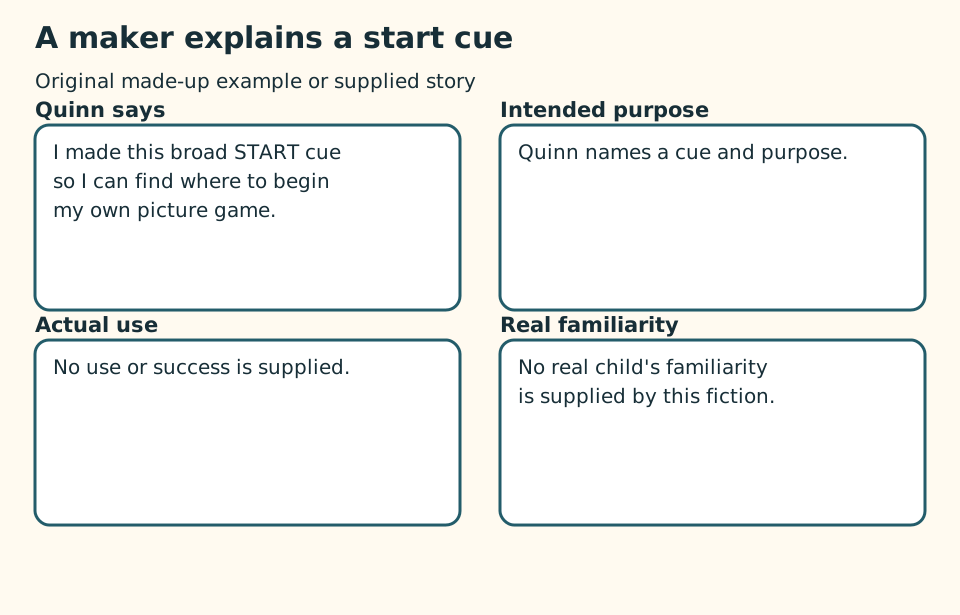
Fictional maker Quinn says, “I made this broad START cue so I can find where to begin my own picture game.” Quinn's account names the cue and its intended purpose. It contains no account of actual use, success, other users or any real child's familiarity. No photograph or real provider game is supplied.
Your questions
- Who tells us why the cue was made? What did they choose?
- Does the story tell us whether it was used? Does it tell us whether a real child knows it?
- What feature would you keep, change or leave out for your own game? What is your reason?
- What could you ask about a game or setup you already know, or keep as an unanswered question?
Your empty response page · Whole source text alternative · Direct whole SVG
Grown-up help
after actual noticed/source/attributed-purpose/real-familiarity distinction instruction, normally after Day 179. This family can extend beyond Day 180. A correct source interpretation does not fill K01 actual familiar exploration.
Save an offered first idea before showing a worked example or a key. Record faithful access help separately from content/design help. Select only components actually taught and review exposure; the public forms are neither secure nor calibrated. Actual child making requires the child's own observed suitable action; adult manufacture is the adult's contribution. Actual familiar exploration is separate from interpreting a new fictional source. Never use response speed, handwriting, touch, compliance, sociability or length as design quality. These are original formative criteria, not official QCAA AP/MC/WW/EX/BA grading.