Public educator selection · preserve first work before criteria or later sources. These pages are public; record prior access.
My responses · The roof-garden puddleYear 4 Science · T1 W7–8 · Responses / A first
Choose all four questions or, if it helps, one at a time. Read the complete selected source below without leaving this task. Tell or show your own idea; a helper can write your exact words. Paper, drawing, pointing, signing, dictation and your usual communication device are welcome.
All 4 questions are shown.
Read the complete selected source
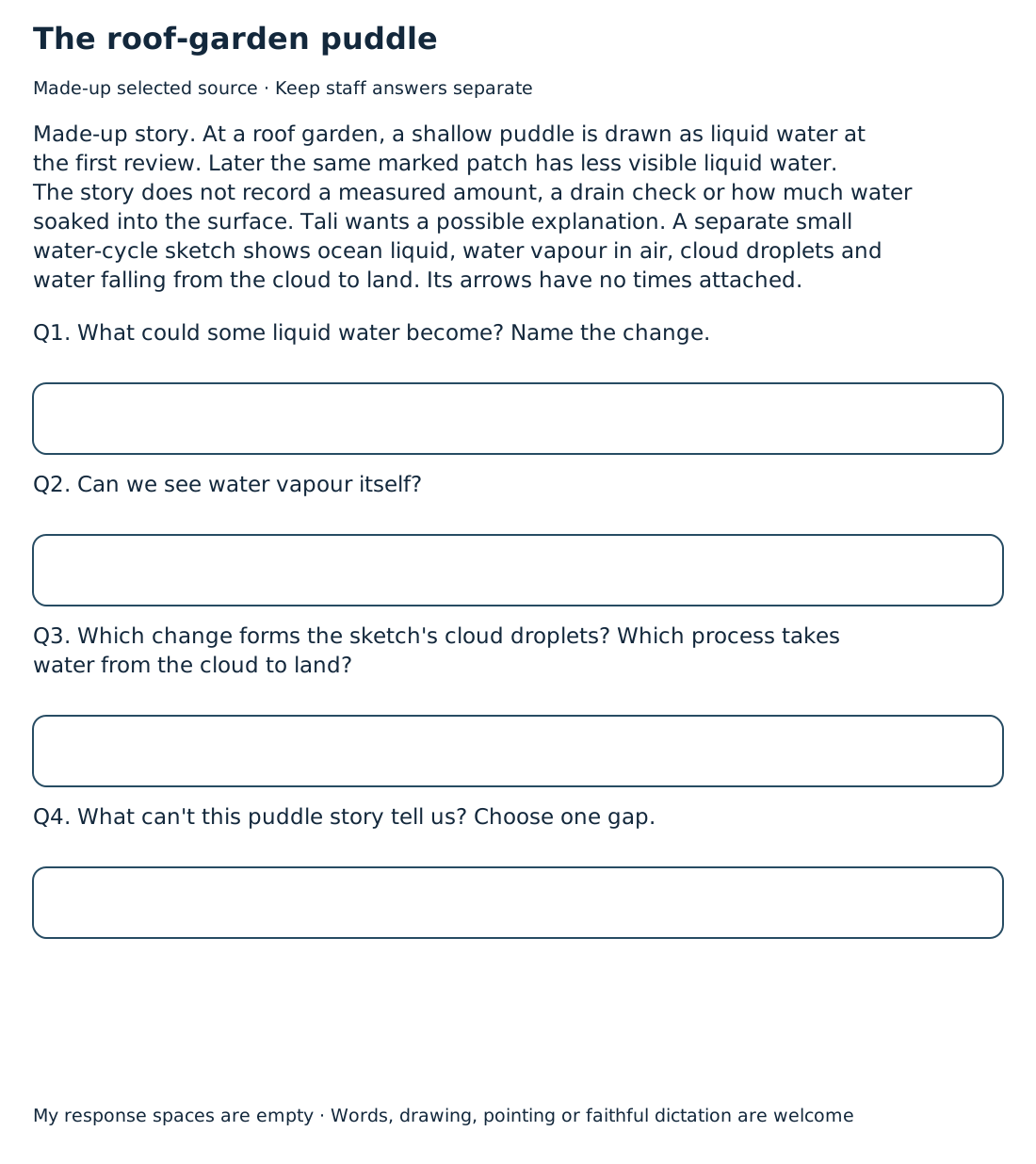
The roof-garden puddle
Made-up story. At a roof garden, a shallow puddle is drawn as liquid water at the first review. Later the same marked patch has less visible liquid water. The story does not record a measured amount, a drain check or how much water soaked into the surface. Tali wants a possible explanation. A separate small water-cycle sketch shows ocean liquid, water vapour in air, cloud droplets and water falling from the cloud to land. Its arrows have no times attached.
Four questions
- What could some liquid water become? Name the change.
- Can we see water vapour itself?
- Which change forms the sketch's cloud droplets? Which process takes water from the cloud to land?
- What can't this puddle story tell us? Choose one gap.
My empty response page · A06 · whole labelled picture · Complete terms · A06 · complete picture words
Tell or show it in your usual way: words, drawing, pointing, signing, typing, dictation or your communication device. Work quietly or privately, pause, ask for a helper, or return later. Sharing and recording are optional.
Grown-up help
Use after Day 34, following relevant teaching and exposure review. This is original supplied fiction. A neutral reader may read every sentence and question; record help.
Separate staff guide · Teacher desk
Modified from Year 4 Science alignment, standard elaborations and Years 3–4 techniques and conditions, © State of Queensland (QCAA) 2023, covered CC BY 4.0 with exceptions. Our task criteria are original; these are not official A–E bands. Actual folio and on-balance professional judgment remain necessary.
These spaces begin empty. Previous, Next, reading the source and switching views keep your words. Leaving, returning or reloading starts empty. Copy what you want to keep, or show all questions, open the source and print before leaving. This page has no submission or saving service.
Tell or show it in your usual way: words, drawing, pointing, signing, typing, dictation or your communication device. Work quietly or privately, pause, ask for a helper, or return later. Sharing and recording are optional.
Grown-up help
Separate staff guide. The source stays available; neutral reading/recording is allowed without coaching an answer. Record actual date/exposure/help and response, not an inferred physical investigation.
Modified from Year 4 Science alignment, standard elaborations and Years 3–4 techniques and conditions, © State of Queensland (QCAA) 2023, covered CC BY 4.0 with exceptions. Our task criteria are original; these are not official A–E bands. Actual folio and on-balance professional judgment remain necessary.
About this resource
Reviewed source editionSource review is complete for this two-week edition. Local suitability and classroom use still need review. Earlier candidate or pending-review words are retained in the original files; full-year coverage, translations and audio are not claimed.
Labels and search exclusions are distribution guidance; they do not authenticate or restrict access.
Exact source: 3531c059f44c934e1a70c6cde632792baa000c31 · 2026-10-09. Source edition, roles and hashes
Complete source and rights notices
Keep these full notices with copies of this resource. Learning text, software, art and outside sources keep their own terms.