Day 35 · Try a fresh water story
Start: “Read a new story. Show what its clues tell you.”
Purpose: Apply taught water-process meanings to fresh A/B sources and choose the next teaching need.
Prepare
Read today's complete model and two contexts before the session. Paper, a pencil and the full written picture words are sufficient. Optional actual water work follows ordinary preparation; the teacher chooses suitable familiar materials/instruments. Use today's three routes without assigning a fixed learning-style label.
Run the session
- Reconnect: offer the usual process word cards; confirm access needs and private/quiet response preference.
- Model: rehearse the short unassessed Paint-water caption from C09 (the fictional art-room water dish); keep fresh A/B stories and worked answers closed until assessment use.
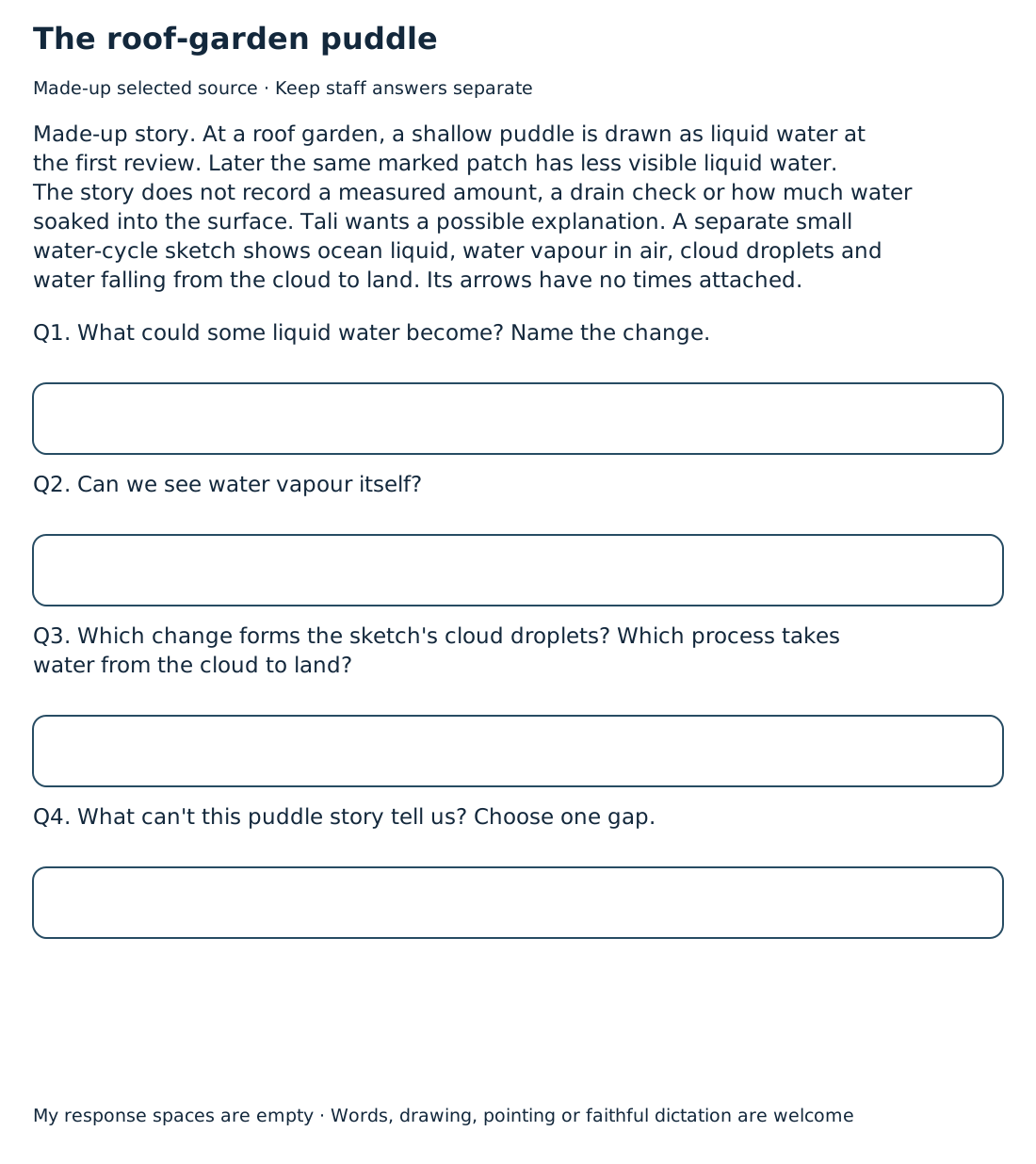
- Try: give Fresh A as the new source and its four blank own-response prompts. Keep source visible; allow breaks and the usual communication support.
- Compare: teacher checks each actual response against its small criterion and records assistance. Correct answers to supplied stories do not establish an actual investigation or instrument use.
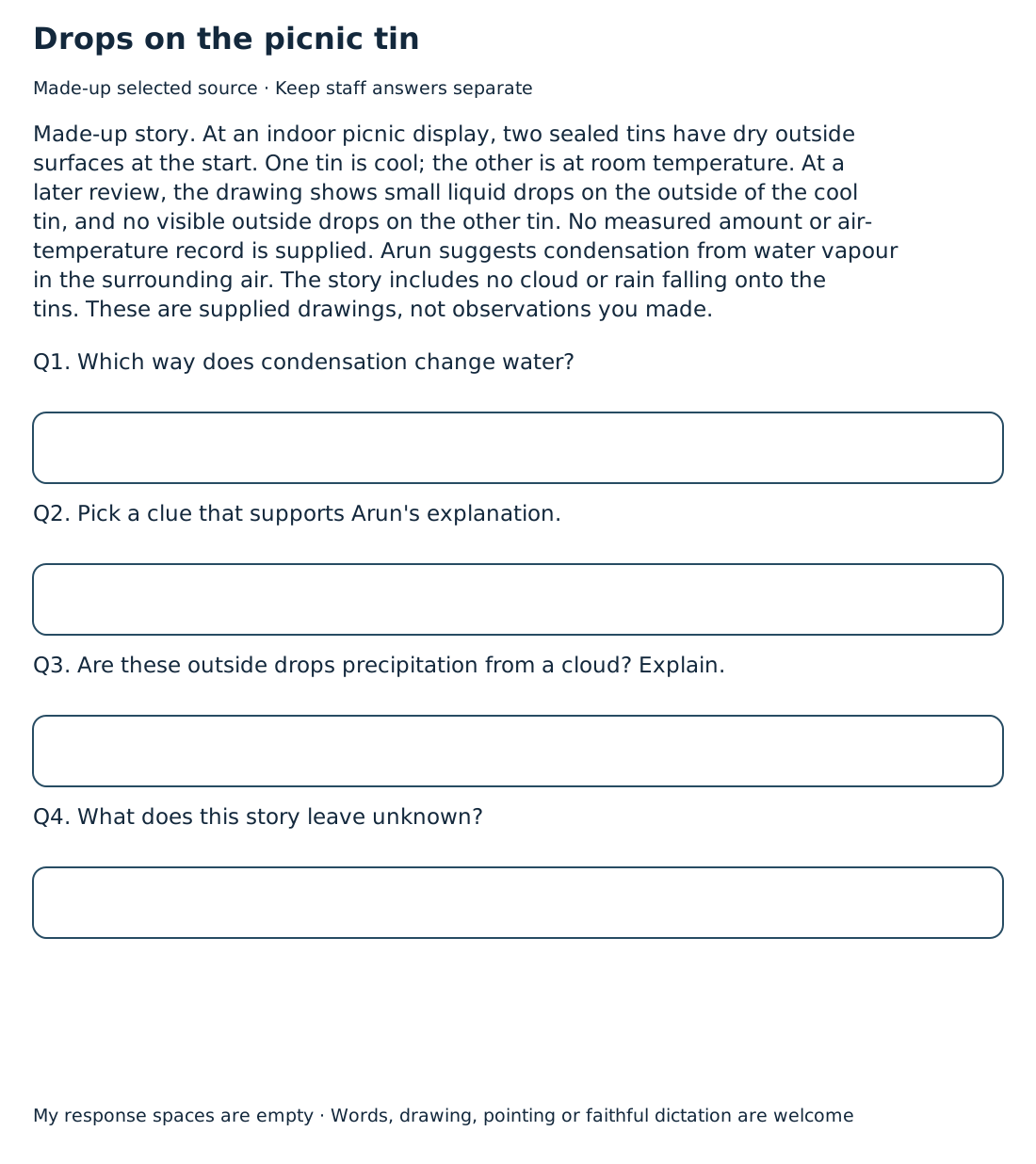
- Make: if helpful use Fresh B as a distinct condensation transfer task after a break or another sitting. It is not required for children already overloaded; date each actual response separately.
- Exit: choose one next lesson action: revisit a state direction, refine a clue or move on. Use a later form only after the relevant teaching.
Three ways in
Source and blank sheet
Use the complete fresh source and four short prompts; draw or write answers privately on paper.
Worked ordinary reasoning: Own response starts empty. The adult uses the separate worked guide only after the attempt.
Read, point, explain
Adult reads the same whole source and prompt neutrally; child points to process cards and dictates explanations without answer coaching.
Worked ordinary reasoning: Record the child's selected process and actual reason, plus what the helper read or moved.
One question at a time
Use the digital source with one prompt shown at a time and a back route; retain source access and all prior work.
Worked ordinary reasoning: No automatic score or worked answer appears on the own-response page; unfinished prompts stay empty.
Look and choose the next teaching
Actual fresh response per criterion, with source/support/date; no inferred mastery from completion clicks.
Teach the smallest identified need using C10 or the two-state cards, then offer an unrelated later story.
Today's complete resources
A06 · whole labelled picture · A06 · complete picture words
A07 · whole labelled picture · A07 · complete picture words
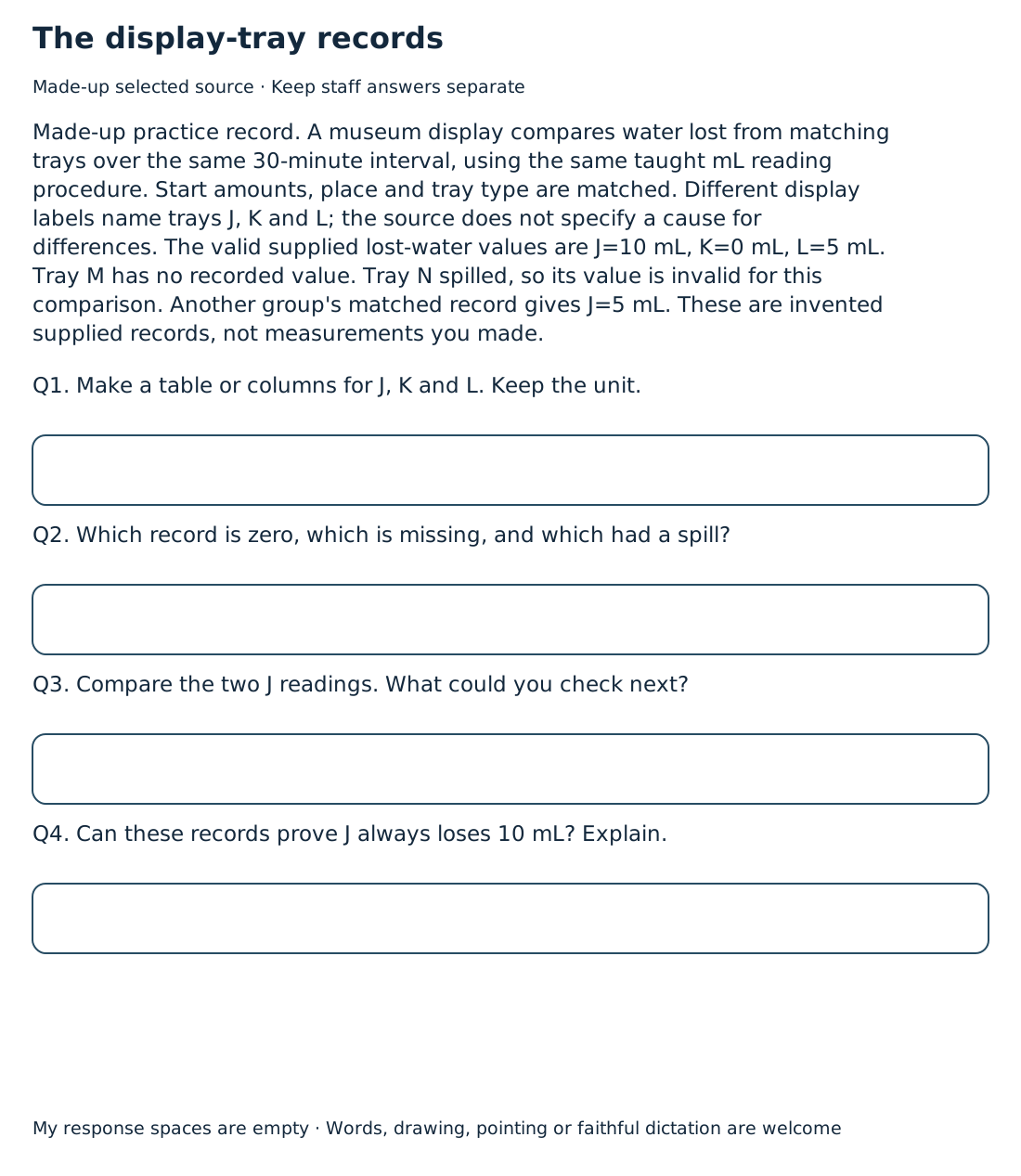
A08 · whole labelled picture · A08 · complete picture words
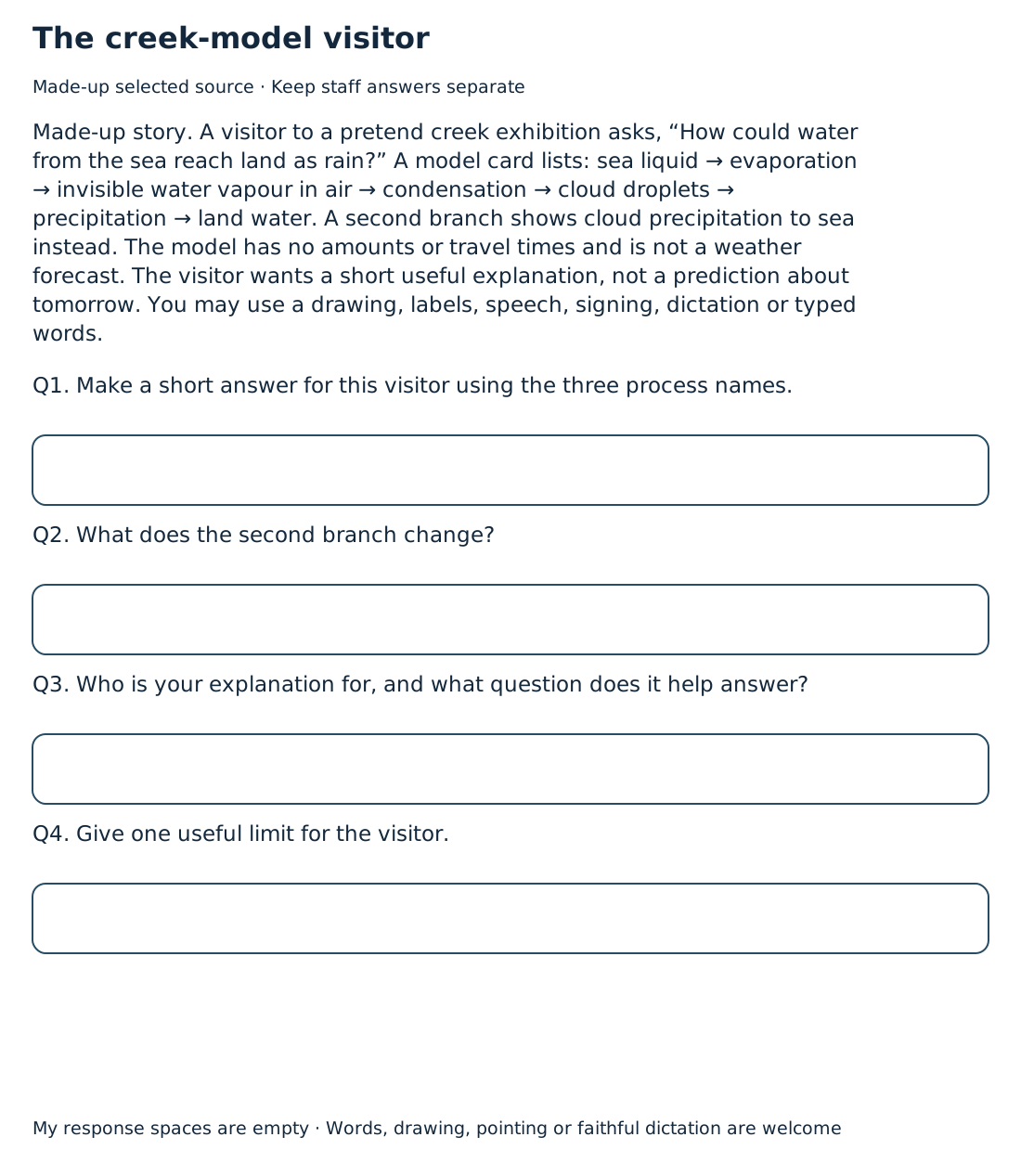
A09 · whole labelled picture · A09 · complete picture words
Short child start · Written read-aloud · Water Trail and paper
Partial opportunities: AC9S4U02, AC9S4I01, AC9S4I06 · Full mapping and limits
Grown-up help
Allow source access and neutral reading/support. Keep supplied story, child response, helper actions and actual observation distinct. Use component-specific criteria after the response, not a model answer before it. Suggested six-move timing 4/7/12/8/6/3 minutes may be split; there is no performance timer.
Modified from Year 4 Science alignment, standard elaborations and Years 3–4 techniques and conditions, © State of Queensland (QCAA) 2023, covered CC BY 4.0 with exceptions. Our task criteria are original; these are not official A–E bands. Actual folio and on-balance professional judgment remain necessary.