Teacher plan · Day 67
About 35–45 minutes, or several shorter visits. This is an unpiloted planning suggestion, not a QCAA condition or a required dose.
Prepare and access
Prepare scrap paper, suitable large counters and labels. Prices/fees/offers and transport capacities are fictional. Device use is optional. Hide models before individual work.
• Keep the mathematical purpose when changing mode. Do not assume a diagnosis predicts a preferred way to learn.
• Offer a quiet place, one instruction at a time, a preview of the steps, a pause card and a visible finish point. No countdown, flashing rewards or forced sound.
• Provide large text, high contrast, plain borders and a complete text alternative to each visual. Colour must never carry the only meaning.
• For motor access, use a selection-and-destination control rather than drag-only interaction, large physical pieces or an adult moving pieces as directed.
• For language access, explain group, each, total, left, fee, estimate and budget using the current story. Home-language explanations and bilingual notes are welcome; mathematical reasoning is assessed separately from spelling or English fluency.
• Reduce a number range or show part of a model when appropriate, then record the change. These supports do not certify the original task independently completed.
• No translation is represented as verified without a fluent reviewer and a recorded version. No invented First Nations language words, stories or cultural designs; seek the appropriate community’s permission and language guidance before a local cultural adaptation.
Complete day sequence
Day67 · An estimate is a check, not a receipt
Purpose: Choose and explain rounding or bounds, then recognise when an exact calculation is needed near a budget limit.
Materials: scrap paper,labelled groups,suitable large counters; plain fictional price/fee cards when relevant. No bought kit,device or printer required.
Demonstration · D67
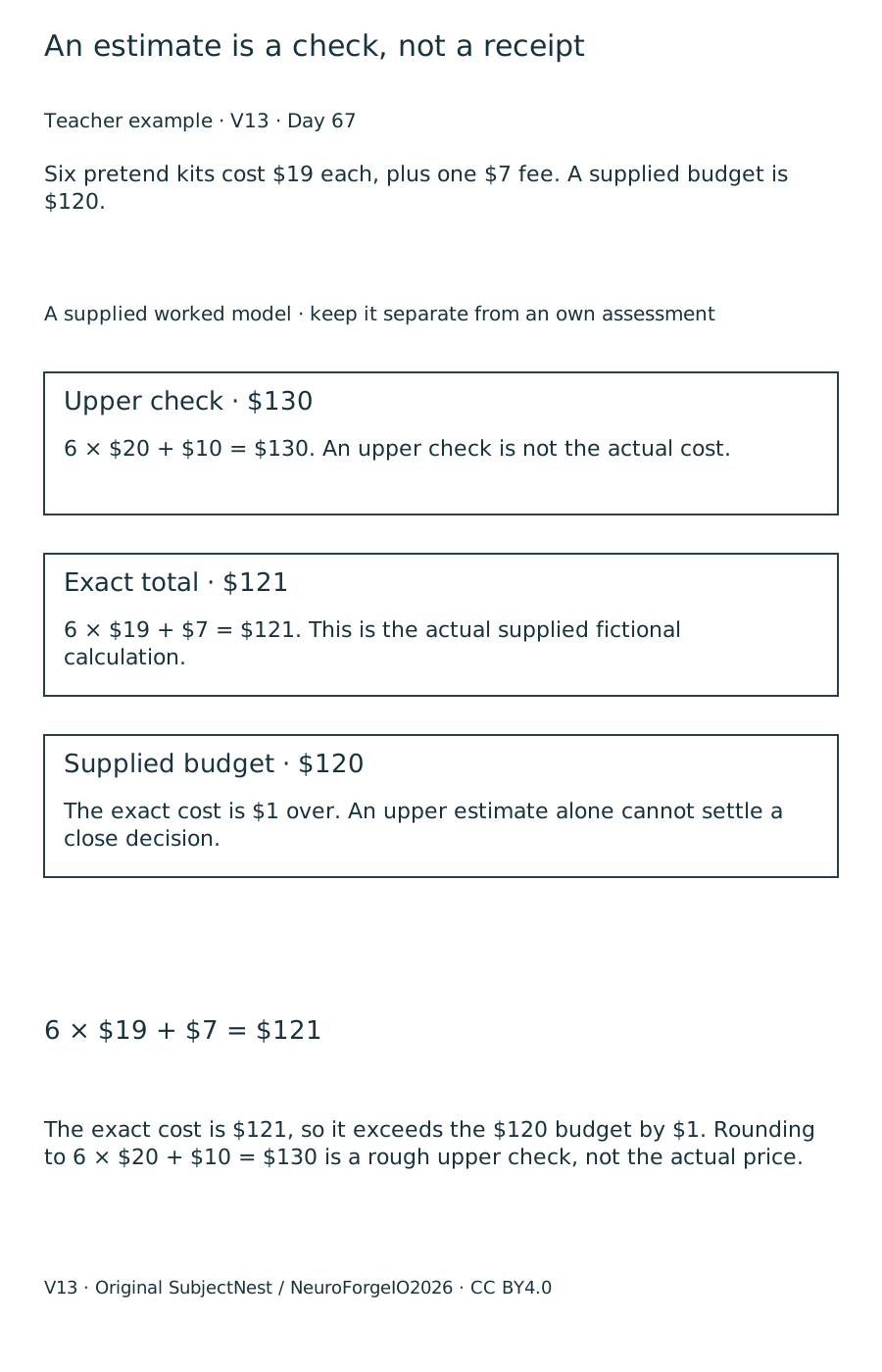
Six pretend kits cost $19 each, plus one $7 fee. A supplied budget is $120.
Before the exact calculation, round each $19 price up to $20 and the $7 fee up to $10. Explain why the resulting $130 is an upper estimate. It exceeds $120, but an upper estimate alone cannot prove that the actual total exceeds $120. Now use 6 × 20 − 6 = 114, then add 7 to get 121. This exact result does establish an overrun of $1. Invite the learner to describe the direction of rounding. A different sensible estimate is acceptable when its role and limitations are explained.
Model: 6 × $19 + $7 = $121. The exact cost is $121, so it exceeds the $120 budget by $1. Rounding to 6 × $20 + $10 = $130 is a rough upper check, not the actual price.
Transfer probe: Four $18 kits plus a $7 fee cost $79. The upper rounded estimate $90 exceeds an $80 budget, yet the exact price fits. This counterexample prevents treating every upper estimate as a purchase decision.
Watch for: Calling an estimate the actual total; inferring 'cannot afford' solely from an upper estimate over budget; rounding a one-off fee once per kit.
Three complete learner briefs
A: Four pretend kits cost $18 each, plus one $7 fee. The budget is $80.
Teacher example: 4 × $18 + $7 = $79; $1 left. Provided estimate $90 is a check, not the paid cost.
B: Six pretend sets cost $17 each, plus one $9 fee. The budget is $110.
Teacher example: 6 × $17 + $9 = $111; $1 over. Provided estimate $130 is a check, not the paid cost.
C: Eight pretend packs cost $23 each, plus one $12 fee. The budget is $200. Explain why rounding down to $170 is not enough to decide.
Teacher example: 8 × $23 + $12 = $196; $4 left. Provided estimate $170 is a check, not the paid cost.
Own, check and next
Use W07's four empty spaces and a complete selected brief. Ask for known/unknown quantities, model, sentence/strategy, check and useful message. Use C13/C14 individually and record actual support; copied work is not independent evidence. If needed choose the corresponding V01–V08target/fullN01–N32fresh mini-lesson. H07/X07 are optional new settings, not compulsory extra workload.
Complete class routine
• Connect: 3–5 minutes. Read the purpose. Ask what the numbers count and which amount is missing. Permit quiet thinking before replies.
• Model: 7–10 minutes. Use the day’s exact demonstration. Point to every term in the representation. Show the worked answer as a teacher example, then remove it before individual work.
• Try: 10–15 minutes. Learner chooses A, B or C after the teacher checks number demand. Make, draw, explain, sign, point or type; adults may scribe exactly what is dictated. Ask for the contextual unit and one check.
• Compare: 5–8 minutes. Share two strategies with consent. A learner may use an anonymous sample or work privately. Discuss the supplied work, not the person.
• Exit: 3–5 minutes. Use a C item individually. Record mathematical reasoning and the support given. Revisit the matching next-teaching target when needed.
Give the material
Learner day · Full worksheet/three briefs · Supplied teacher model · Full model alternative · Complete written read-aloud
First neutral exit · Second neutral exit · First staff exit · Second staff exit
Full worksheet staff note
Use the complete Day67 plan and C13/C14 exit. Record route and supports. Accept clear equivalent models; drawing neatness and spelling are not maths criteria.