SubjectNest · Year 3 Science · Term 1 · Weeks 09–10 · sequence Days 41–50
V19 · C-later exact source/four-prompt own mat
Whole original plane. For ordinary-size sheets use its matching HTML paper route; do not shrink this tall vector onto one sheet.
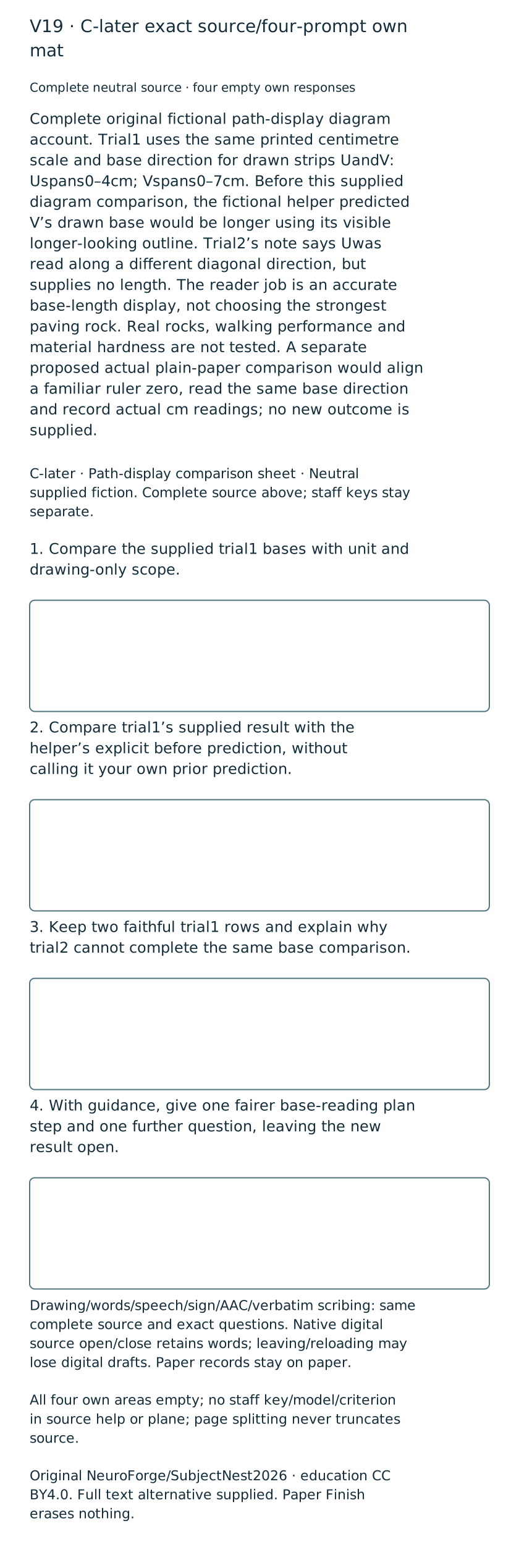
Complete text alternative
V19 — C-later exact source/four-prompt own mat. Original proposed aid. Role: Capture owned responses/decline after actual opportunity with exact whole source/prompt identity in every mode.

Complete visible source:
Complete original fictional path-display diagram account. Trial1 uses the same printed centimetre scale and base direction for drawn strips UandV: Uspans0–4cm; Vspans0–7cm. Before this supplied diagram comparison, the fictional helper predicted V’s drawn base would be longer using its visible longer-looking outline. Trial2’s note says Uwas read along a different diagonal direction, but supplies no length. The reader job is an accurate base-length display, not choosing the strongest paving rock. Real rocks, walking performance and material hardness are not tested. A separate proposed actual plain-paper comparison would align a familiar ruler zero, read the same base direction and record actual cm readings; no new outcome is supplied.

Complete layout and relationships:
Multi-sheet text-first mat: source identity and complete neutral source first; four numbered exact prompts follow in order, each above a generous EMPTY own rectangle. Repeat source identity/honest page order if extra pages required; no unreadably shrunken source. No criterion/model/next lesson or answer-hint connector. Source remains complete and readable as text. Digital native source disclosure initially closed has identical whole neutral source; four own fields genuinely empty. Spoken/signed/AAC/verbatim scribing uses exact prompts one at a time if wanted with read-back confirmation.

Visible labels in reading order:
V19 C-later neutral supplied fiction
Path-display comparison sheet
Read/hear complete source in place
1. Compare the supplied trial1 bases with unit and drawing-only scope.
2. Compare trial1’s supplied result with the helper’s explicit before prediction, without calling it your own prior prediction.
3. Keep two faithful trial1 rows and explain why trial2 cannot complete the same base comparison.
4. With guidance, give one fairer base-reading plan step and one further question, leaving the new result open.
Own response1 empty
Own response2 empty
Own response3 empty
Own response4 empty
Open/close source keeps words; leaving/reload may lose digital drafts
Paper records stay on paper

Own-work state: All four own areas empty; no staff key/model/criterion in source help or plane; page splitting never truncates source.
No hidden sound, colour-only clue, actual experiment, local observation, reader success or automatic verdict. All visible source relationships are given as text; helper reads verbatim and leaves own areas blank.

Actual generated original plane:
1. Compare the supplied trial1 bases with unit and drawing-only scope. — genuinely empty interior
2. Compare trial1’s supplied result with the helper’s explicit before prediction, without calling it your own prior prediction. — genuinely empty interior
3. Keep two faithful trial1 rows and explain why trial2 cannot complete the same base comparison. — genuinely empty interior
4. With guidance, give one fairer base-reading plan step and one further question, leaving the new result open. — genuinely empty interior

Complete actual visible wording, in reading order:
V19 · C-later exact source/four-prompt own mat
Complete neutral source · four empty own responses
Complete original fictional path-display diagram account. Trial1 uses the same printed centimetre scale and base direction for drawn strips UandV: Uspans0–4cm; Vspans0–7cm. Before this supplied diagram comparison, the fictional helper predicted V’s drawn base would be longer using its visible longer-looking outline. Trial2’s note says Uwas read along a different diagonal direction, but supplies no length. The reader job is an accurate base-length display, not choosing the strongest paving rock. Real rocks, walking performance and material hardness are not tested. A separate proposed actual plain-paper comparison would align a familiar ruler zero, read the same base direction and record actual cm readings; no new outcome is supplied.
C-later · Path-display comparison sheet · Neutral supplied fiction. Complete source above; staff keys stay separate.
1. Compare the supplied trial1 bases with unit and drawing-only scope.
2. Compare trial1’s supplied result with the helper’s explicit before prediction, without calling it your own prior prediction.
3. Keep two faithful trial1 rows and explain why trial2 cannot complete the same base comparison.
4. With guidance, give one fairer base-reading plan step and one further question, leaving the new result open.
Drawing/words/speech/sign/AAC/verbatim scribing: same complete source and exact questions. Native digital source open/close retains words; leaving/reloading may lose digital drafts. Paper records stay on paper.
All four own areas empty; no staff key/model/criterion in source help or plane; page splitting never truncates source.
Original NeuroForge/SubjectNest2026 · education CC BY4.0. Full text alternative supplied. Paper Finish erases nothing.
Whole canvas840×2538. This large readable vector can be zoomed. Matching HTML paper pages paginate text and empty responses instead of shrinking the whole vector onto one sheet.