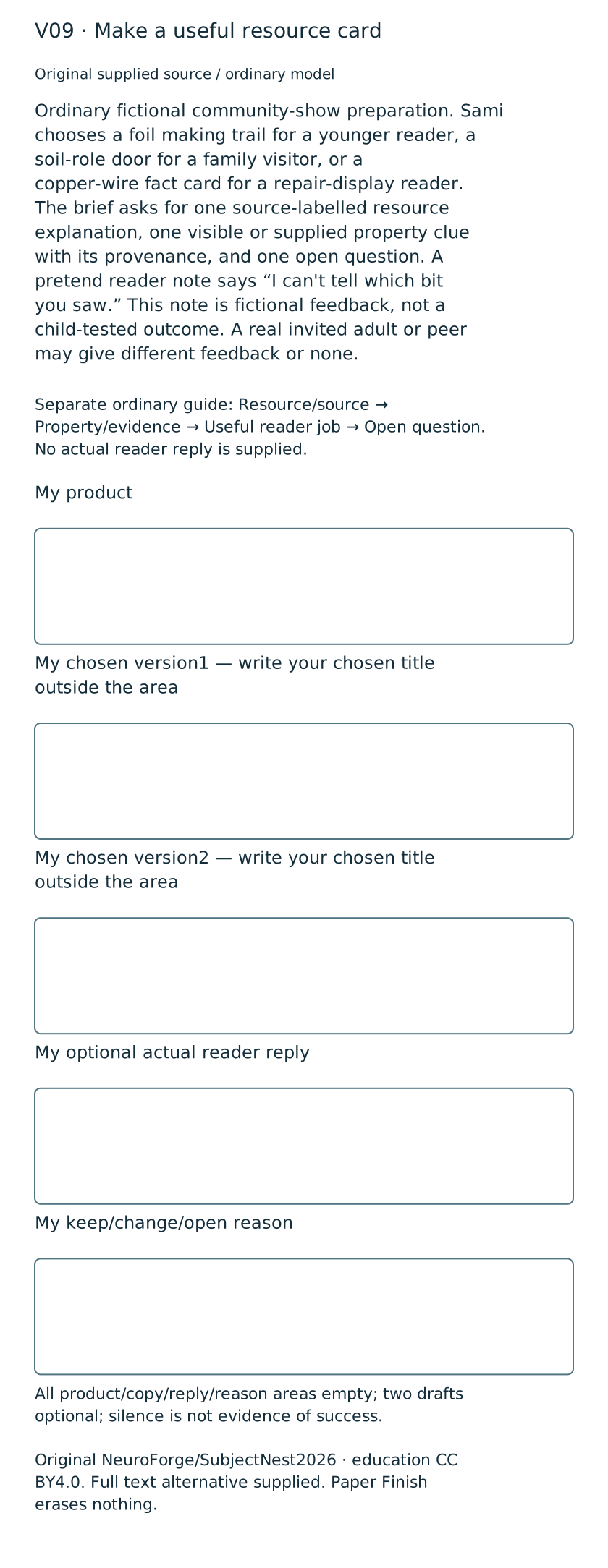
Complete text alternative
V09 — Make a useful resource card. Original proposed aid. Role: Make a pocket label/visitor card/quiet explanation for a chosen purpose; optional actual reader and purposeful revision.

Complete visible source:
Ordinary fictional community-show preparation. Sami chooses a foil making trail for a younger reader, a soil-role door for a family visitor, or a copper-wire fact card for a repair-display reader. The brief asks for one source-labelled resource explanation, one visible or supplied property clue with its provenance, and one open question. A pretend reader note says “I can't tell which bit you saw.” This note is fictional feedback, not a child-tested outcome. A real invited adult or peer may give different feedback or none.

Complete layout and relationships:
Whole ordinary source then left guide with process headings Resource/source→Property/evidence→Useful reader job→Open question, not a held answer. Right own product area entirely empty, heading outside. Below two empty own-copy strips labelled My chosen version1 and My chosen version2. Actual chosen names must top comparison columns; slot numbers preserve identity when names equal/empty. Reader reply area says no reply supplied, optional actual consented reply later. Empty own keep/change/open reason.

Visible labels in reading order:
V09 practical own product
Resource/source
Property/evidence
Useful reader job
Open question
My product
My chosen version1
My chosen version2
No actual reader reply supplied
My keep/change/open reason

Own-work state: All product/copy/reply/reason areas empty; two drafts optional; silence is not evidence of success.
No hidden sound, colour-only clue, actual experiment, local observation, reader success or automatic verdict. All visible source relationships are given as text; helper reads verbatim and leaves own areas blank.

Actual generated original plane:
My product — genuinely empty interior
My chosen version1 — write your chosen title outside the area — genuinely empty interior
My chosen version2 — write your chosen title outside the area — genuinely empty interior
My optional actual reader reply — genuinely empty interior
My keep/change/open reason — genuinely empty interior

Complete actual visible wording, in reading order:
V09 · Make a useful resource card
Original supplied source / ordinary model
Ordinary fictional community-show preparation. Sami chooses a foil making trail for a younger reader, a soil-role door for a family visitor, or a copper-wire fact card for a repair-display reader. The brief asks for one source-labelled resource explanation, one visible or supplied property clue with its provenance, and one open question. A pretend reader note says “I can't tell which bit you saw.” This note is fictional feedback, not a child-tested outcome. A real invited adult or peer may give different feedback or none.
Separate ordinary guide: Resource/source → Property/evidence → Useful reader job → Open question. No actual reader reply is supplied.
My product
My chosen version1 — write your chosen title outside the area
My chosen version2 — write your chosen title outside the area
My optional actual reader reply
My keep/change/open reason
All product/copy/reply/reason areas empty; two drafts optional; silence is not evidence of success.
Original NeuroForge/SubjectNest2026 · education CC BY4.0. Full text alternative supplied. Paper Finish erases nothing.
Whole canvas840×2168. This large readable vector can be zoomed. Matching HTML paper pages paginate text and empty responses instead of shrinking the whole vector onto one sheet.
About this resource
Reviewed source editionSource review is complete for this two-week edition. Local suitability and classroom use still need review. Earlier candidate or pending-review words are retained in the original files; full-year coverage, translations and audio are not claimed.
Exact source: 089d6ac9ec4293ea4b949980b0e79e5cbf08fc82 · 2026-10-13. Source edition, roles and hashes
Complete source and rights notices
Keep these full notices with copies of this resource. Learning text, software, art and outside sources keep their own terms.