The cardboard music-room cards · staff
- Complete matching neutral source
- Child · four blank own fields
- Matching four-question case paper
- V19 · source scene and four blank areas
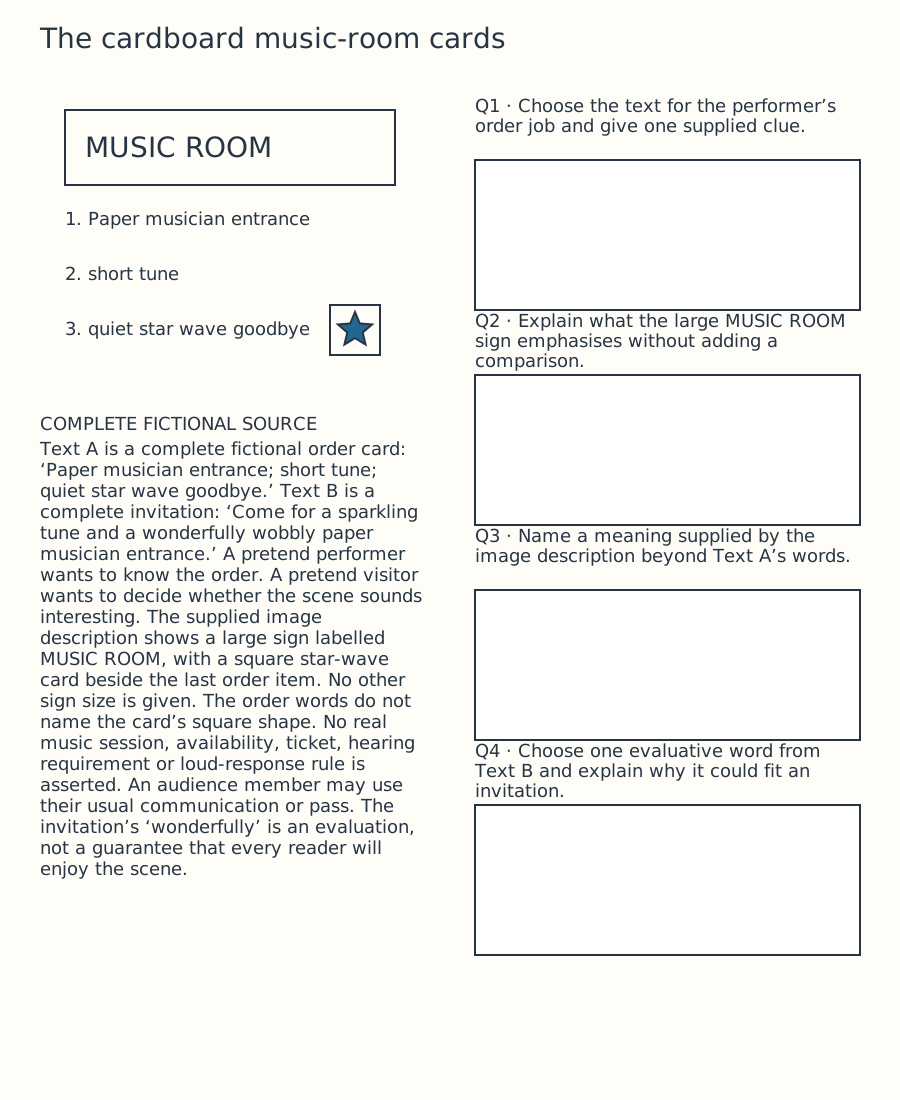
- V19 · complete text alternative
- Ordinary eight-field Reporter Desk paper
- N25 · full follow-on lesson for Q1
- N26 · full follow-on lesson for Q2
- N27 · full follow-on lesson for Q3
- N28 · full follow-on lesson for Q4
The cardboard music-room cards · staff case
Eligibility and exposure
Show the complete matched source only when beginning this case. If the child has already seen its staff worked answers, practised it, or received answer-level help, record that exposure and use it as supported/formative teaching rather than an independent first response. Later is a new source, not an automatic progress test.
Help and actual evidence
Adult reading of the full source, usual communication, larger print, breaks, pointing and exact dictation are allowed; record which. Do not supply a component’s worked answer or criterion before a genuine first response. Reading aloud means this case cannot by itself demonstrate independent decoding; adult pen work cannot demonstrate handwriting.
Complete neutral source
Text A is a complete fictional order card: ‘Paper musician entrance; short tune; quiet star wave goodbye.’ Text B is a complete invitation: ‘Come for a sparkling tune and a wonderfully wobbly paper musician entrance.’ A pretend performer wants to know the order. A pretend visitor wants to decide whether the scene sounds interesting. The supplied image description shows a large sign labelled MUSIC ROOM, with a square star-wave card beside the last order item. No other sign size is given. The order words do not name the card’s square shape. No real music session, availability, ticket, hearing requirement or loud-response rule is asserted. An audience member may use their usual communication or pass. The invitation’s ‘wonderfully’ is an evaluation, not a guarantee that every reader will enjoy the scene.
C-later-Q1
Invitation
Choose the text for the performer’s order job and give one supplied clue.
Component criterion
Chooses A and supports the order purpose with its listed sequence rather than an invented time.
Staff example after an attempt
Text A gives entrance, tune and goodbye in order. It does not supply a real starting time.
Judgement limit
Use this component-specific description with the actual response and recorded help. No point total, A–E level, diagnosis, causal gain or independent-exposure claim.
Next teaching
N25 · AC9E3LY03, AC9E3LA03
C-later-Q2
Invitation
Explain what the large MUSIC ROOM sign emphasises without adding a comparison.
Component criterion
Names the music-room destination/topic and retains the source’s lack of another sign size.
Staff example after an attempt
The sign makes MUSIC ROOM prominent. No comparison with a smaller sign is supplied.
Judgement limit
Use this component-specific description with the actual response and recorded help. No point total, A–E level, diagnosis, causal gain or independent-exposure claim.
Next teaching
N26 · AC9E3LA09, AC9E3LY05
C-later-Q3
Invitation
Name a meaning supplied by the image description beyond Text A’s words.
Component criterion
Identifies the square star-wave card or its relation to the final item as an explicitly supplied added visual meaning.
Staff example after an attempt
The image describes a square card beside the goodbye item; the order sentence does not give that shape.
Judgement limit
Use this component-specific description with the actual response and recorded help. No point total, A–E level, diagnosis, causal gain or independent-exposure claim.
Next teaching
N27 · AC9E3LA09
C-later-Q4
Invitation
Choose one evaluative word from Text B and explain why it could fit an invitation.
Component criterion
Connects ‘sparkling’, ‘wonderfully’ or ‘wobbly’ to an inviting reader effect without treating enjoyment as universal.
Staff example after an attempt
‘Wonderfully’ expresses positive evaluation to make the event appealing. Another reader may still choose not to watch.
Judgement limit
Use this component-specific description with the actual response and recorded help. No point total, A–E level, diagnosis, causal gain or independent-exposure claim.
Next teaching
N28 · AC9E3LA02, AC9E3LY03