Public educator selection · preserve first work before criteria or later sources. These pages are public; record prior access.
The cardboard gallery cards · staffYear 3 English · T1 W9–10 · Teacher · Teacher / Cases / C first
- Complete matching neutral source
- Child · four blank own fields
- Matching four-question case paper
- V15 · source scene and four blank areas · Complete terms
- V15 · complete text alternative
- Ordinary eight-field Reporter Desk paper
- N09 · full follow-on lesson for Q1
- N10 · full follow-on lesson for Q2
- N11 · full follow-on lesson for Q3
- N12 · full follow-on lesson for Q4
The cardboard gallery cards · staff case
Eligibility and exposure
Show the complete matched source only when beginning this case. If the child has already seen its staff worked answers, practised it, or received answer-level help, record that exposure and use it as supported/formative teaching rather than an independent first response. Later is a new source, not an automatic progress test.
Help and actual evidence
Adult reading of the full source, usual communication, larger print, breaks, pointing and exact dictation are allowed; record which. Do not supply a component’s worked answer or criterion before a genuine first response. Reading aloud means this case cannot by itself demonstrate independent decoding; adult pen work cannot demonstrate handwriting.
Complete neutral source
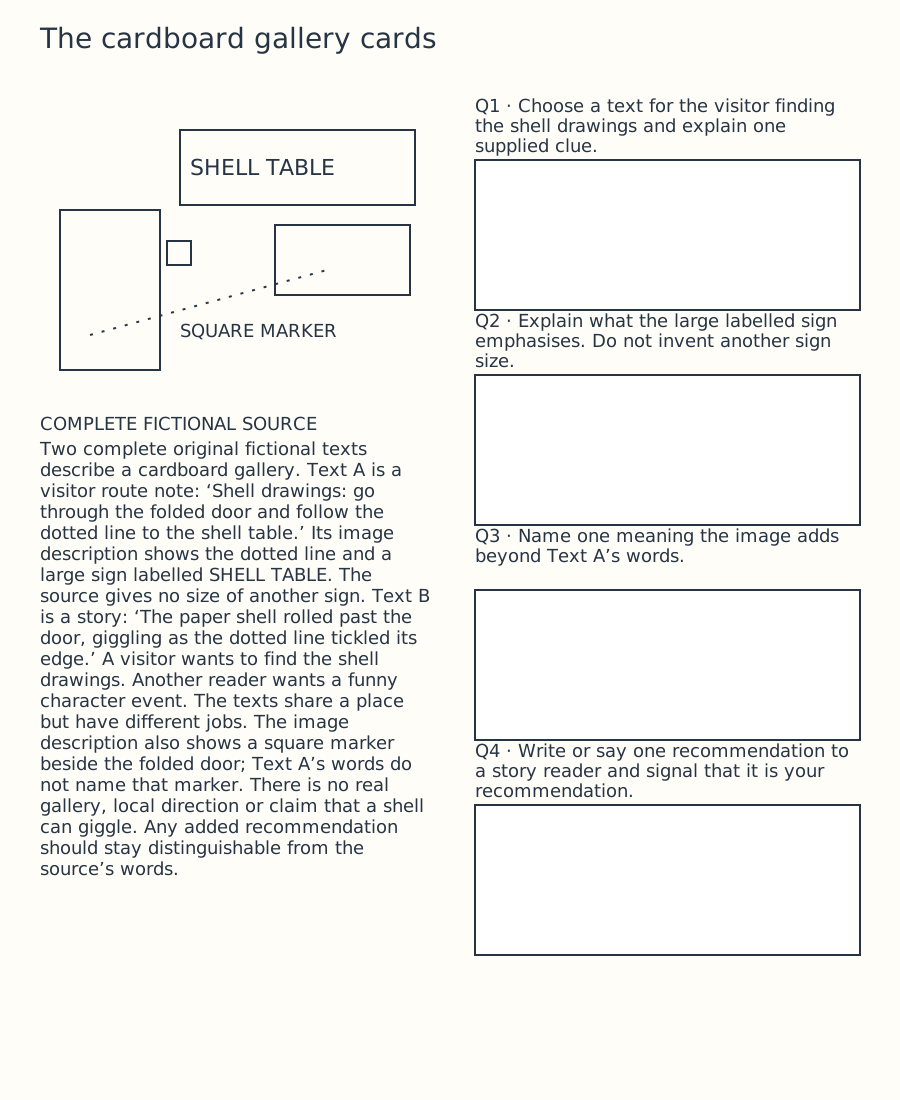
Two complete original fictional texts describe a cardboard gallery. Text A is a visitor route note: ‘Shell drawings: go through the folded door and follow the dotted line to the shell table.’ Its image description shows the dotted line and a large sign labelled SHELL TABLE. The source gives no size of another sign. Text B is a story: ‘The paper shell rolled past the door, giggling as the dotted line tickled its edge.’ A visitor wants to find the shell drawings. Another reader wants a funny character event. The texts share a place but have different jobs. The image description also shows a square marker beside the folded door; Text A’s words do not name that marker. There is no real gallery, local direction or claim that a shell can giggle. Any added recommendation should stay distinguishable from the source’s words.
C-first-Q1
Invitation
Choose a text for the visitor finding the shell drawings and explain one supplied clue.
Component criterion
Chooses A and supports its finding purpose using route labels/instructions or matching path image.
Staff example after an attempt
Text A fits the finding job because it tells the route to the shell table. The story’s giggling event serves a different purpose.
Judgement limit
Use this component-specific description with the actual response and recorded help. No point total, A–E level, diagnosis, causal gain or independent-exposure claim.
Next teaching
N09 · AC9E3LY03, AC9E3LA03
C-first-Q2
Invitation
Explain what the large labelled sign emphasises. Do not invent another sign size.
Component criterion
Connects the large SHELL TABLE sign to the destination, with no unsupported size comparison.
Staff example after an attempt
It emphasises the shell-table destination. The source describes a large sign but gives no smaller sign to compare.
Judgement limit
Use this component-specific description with the actual response and recorded help. No point total, A–E level, diagnosis, causal gain or independent-exposure claim.
Next teaching
N10 · AC9E3LA09, AC9E3LY05
C-first-Q3
Invitation
Name one meaning the image adds beyond Text A’s words.
Component criterion
Identifies the square door marker or another explicitly supplied visual relation absent from the words.
Staff example after an attempt
The square marker beside the door is shown by the image description but is not named in Text A’s route sentence.
Judgement limit
Use this component-specific description with the actual response and recorded help. No point total, A–E level, diagnosis, causal gain or independent-exposure claim.
Next teaching
N11 · AC9E3LA09
C-first-Q4
Invitation
Write or say one recommendation to a story reader and signal that it is your recommendation.
Component criterion
Recommends B for an imaginative/funny event with a source-supported reason, clearly as a personal recommendation.
Staff example after an attempt
‘I recommend Text B if you want a funny event, because the shell giggles.’ is a recommendation, not a new source quote.
Judgement limit
Use this component-specific description with the actual response and recorded help. No point total, A–E level, diagnosis, causal gain or independent-exposure claim.
Next teaching
N12 · AC9E3LY01, AC9E3LY03, AC9E3LA02
About this resource
Reviewed source editionSource review is complete for this two-week edition. Local suitability and classroom use still need review. Earlier candidate or pending-review words are retained in the original files; full-year coverage, translations and audio are not claimed.
Labels and search exclusions are distribution guidance; they do not authenticate or restrict access.
Exact source: 335608627fe619359a5ab79b7cf66ebfdf290807 · 2026-10-13. Source edition, roles and hashes
Complete source and rights notices
Keep these full notices with copies of this resource. Learning text, software, art and outside sources keep their own terms.