Public educator selection · preserve first work before criteria or later sources. These pages are public; record prior access.
The lantern drawing parade · staffYear 3 English · T1 W9–10 · Teacher · Teacher / Cases / B later
- Complete matching neutral source
- Child · four blank own fields
- Matching four-question case paper
- V18 · source scene and four blank areas · Complete terms
- V18 · complete text alternative
- Ordinary eight-field Reporter Desk paper
- N21 · full follow-on lesson for Q1
- N22 · full follow-on lesson for Q2
- N23 · full follow-on lesson for Q3
- N24 · full follow-on lesson for Q4
The lantern drawing parade · staff case
Eligibility and exposure
Show the complete matched source only when beginning this case. If the child has already seen its staff worked answers, practised it, or received answer-level help, record that exposure and use it as supported/formative teaching rather than an independent first response. Later is a new source, not an automatic progress test.
Help and actual evidence
Adult reading of the full source, usual communication, larger print, breaks, pointing and exact dictation are allowed; record which. Do not supply a component’s worked answer or criterion before a genuine first response. Reading aloud means this case cannot by itself demonstrate independent decoding; adult pen work cannot demonstrate handwriting.
Complete neutral source
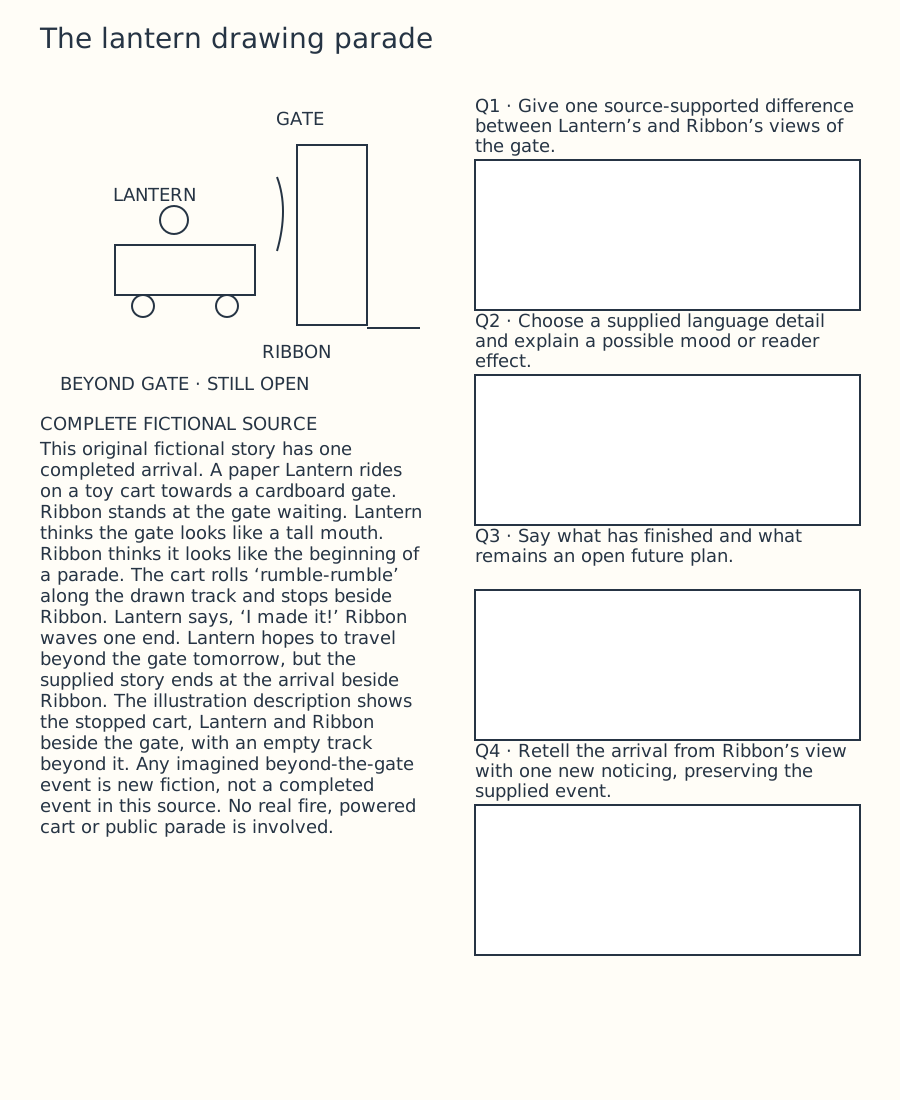
This original fictional story has one completed arrival. A paper Lantern rides on a toy cart towards a cardboard gate. Ribbon stands at the gate waiting. Lantern thinks the gate looks like a tall mouth. Ribbon thinks it looks like the beginning of a parade. The cart rolls ‘rumble-rumble’ along the drawn track and stops beside Ribbon. Lantern says, ‘I made it!’ Ribbon waves one end. Lantern hopes to travel beyond the gate tomorrow, but the supplied story ends at the arrival beside Ribbon. The illustration description shows the stopped cart, Lantern and Ribbon beside the gate, with an empty track beyond it. Any imagined beyond-the-gate event is new fiction, not a completed event in this source. No real fire, powered cart or public parade is involved.
B-later-Q1
Invitation
Give one source-supported difference between Lantern’s and Ribbon’s views of the gate.
Component criterion
Names tall-mouth impression versus parade beginning; explains a different noticing rather than requiring a prescribed feeling.
Staff example after an attempt
Lantern notices a tall-mouth shape, while Ribbon sees a parade beginning. The setting can affect each character differently.
Judgement limit
Use this component-specific description with the actual response and recorded help. No point total, A–E level, diagnosis, causal gain or independent-exposure claim.
Next teaching
N21 · AC9E3LE02, AC9E3LE03
B-later-Q2
Invitation
Choose a supplied language detail and explain a possible mood or reader effect.
Component criterion
Connects ‘rumble-rumble’, ‘tall mouth’ or ‘I made it’ to a plausible effect, supported by that detail.
Staff example after an attempt
‘Rumble-rumble’ can help a reader imagine the cart’s movement; ‘I made it’ can make arrival feel relieved. Other supported readings are possible.
Judgement limit
Use this component-specific description with the actual response and recorded help. No point total, A–E level, diagnosis, causal gain or independent-exposure claim.
Next teaching
N22 · AC9E3LE03, AC9E3LE04
B-later-Q3
Invitation
Say what has finished and what remains an open future plan.
Component criterion
Identifies arrival beside Ribbon as completed and beyond-gate travel as hoped-for future.
Staff example after an attempt
The cart arrives beside Ribbon. Travelling beyond the gate tomorrow is a hope, not a completed journey.
Judgement limit
Use this component-specific description with the actual response and recorded help. No point total, A–E level, diagnosis, causal gain or independent-exposure claim.
Next teaching
N23 · AC9E3LY05, AC9E3LA08
B-later-Q4
Invitation
Retell the arrival from Ribbon’s view with one new noticing, preserving the supplied event.
Component criterion
Makes a Ribbon-perspective retelling that ends at the arrival, with new thought understood as fiction.
Staff example after an attempt
‘I waved as the cart rumbled up. The gate looked ready for our tiny parade. Lantern stopped beside me.’ changes noticing without completing tomorrow’s trip.
Judgement limit
Use this component-specific description with the actual response and recorded help. No point total, A–E level, diagnosis, causal gain or independent-exposure claim.
Next teaching
N24 · AC9E3LE05, AC9E3LY06
About this resource
Reviewed source editionSource review is complete for this two-week edition. Local suitability and classroom use still need review. Earlier candidate or pending-review words are retained in the original files; full-year coverage, translations and audio are not claimed.
Labels and search exclusions are distribution guidance; they do not authenticate or restrict access.
Exact source: 335608627fe619359a5ab79b7cf66ebfdf290807 · 2026-10-13. Source edition, roles and hashes
Complete source and rights notices
Keep these full notices with copies of this resource. Learning text, software, art and outside sources keep their own terms.