Use this case
Offer the neutral source and four questions after the relevant learning opportunity. Keep staff examples and next teaching on the teacher pages.
Child materials and paper
- C-first · complete neutral source
- C-first · four questions and own response spaces
- C-first · matching four-question paper mat (V15)
- C-first · full paper-mat text alternative (V15)
After reviewing the child’s own work
Choose the relevant next lesson. These are supported teaching accounts, separate from the child’s case responses.
Complete neutral source
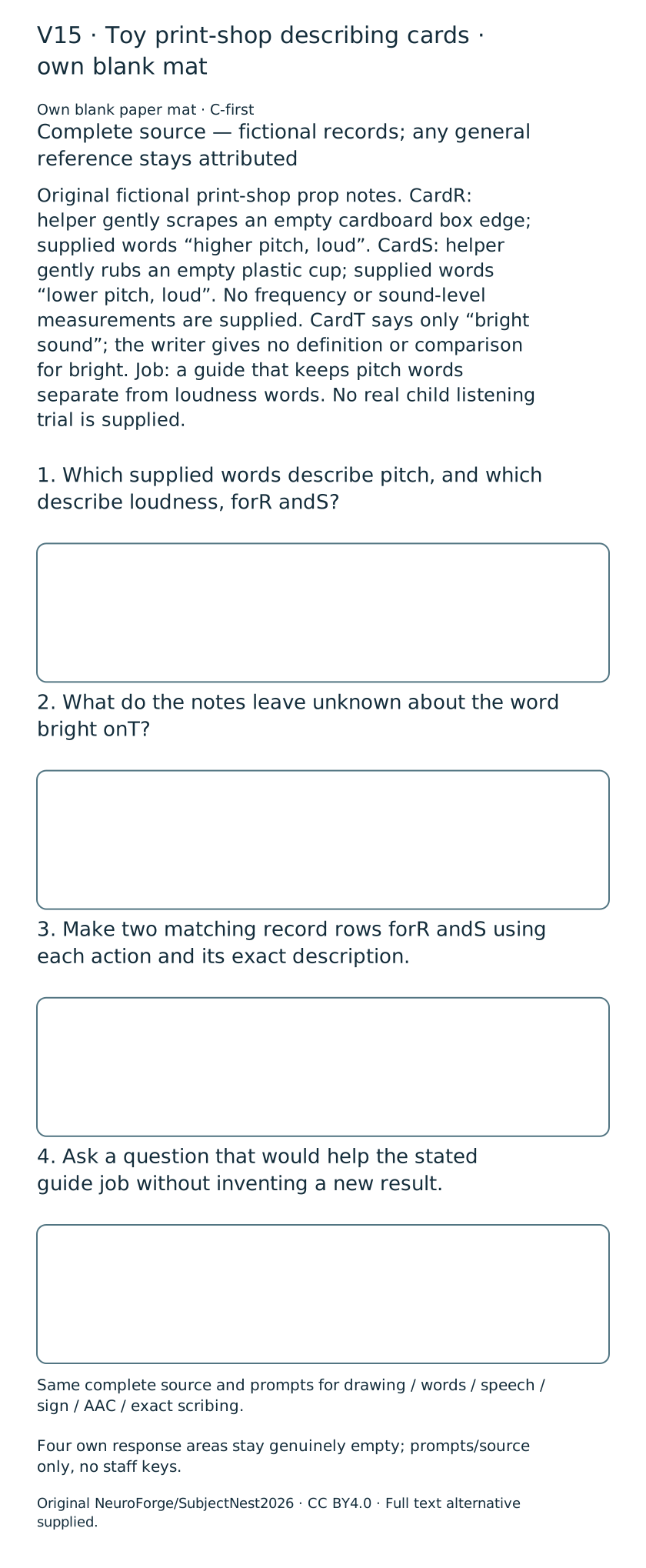
Original fictional print-shop prop notes. CardR: helper gently scrapes an empty cardboard box edge; supplied words “higher pitch, loud”. CardS: helper gently rubs an empty plastic cup; supplied words “lower pitch, loud”. No frequency or sound-level measurements are supplied. CardT says only “bright sound”; the writer gives no definition or comparison for bright. Job: a guide that keeps pitch words separate from loudness words. No real child listening trial is supplied.
Components
Accept other responses
Accept a different source-faithful response in text/drawing/speech/sign/AAC/exact scribing. No required wording, hearing performance or neatness score. Apply only the exact prompt/criterion; no unstated physical action or result required.
Exact component criterion
SeparatesR higher/S lower pitch from shared loud loudness wording, as supplied descriptions rather than measurements.
Exact prompt
Which supplied words describe pitch, and which describe loudness, forR andS?
Full individual next learning
Child invitation
Describe each outline with two separate labels and explain what changed.
Guided different context
Build two paper tower outlines with same drawn height and different widths.
Id
N09
Mode opportunity
This is supported teaching after review. Actual performing, reasoning about supplied stories and model construction are recorded separately. New-context transfer is a small observed step, not annual mastery or a new official grade.
Next decision
If the named distinction is still unclear, return to two source-labelled cards in this unrelated context and one prompt at a time. If clear, offer a different job/source after further learning; do not retry this held case with the staff model rehearsed.
Observable next evidence
Child keeps two descriptive categories separate; no sound claim or physical measurement is inferred.
Ordinary possible model
Tall is not a substitute for wide.
Teacher preparation
Full account/model and a separate blank child page; cards or paper drawings as named in the guided context. Offer pointing/AAC/exact scribing and quiet helper operation. No source collection or public publication is required.
Teacher sequence
- Read the complete new account and ask which event/reference is actually supplied before showing its ordinary model.
- Model tall/narrow with first source, guide same-height/different-width choice, then let child describe a new outline in their own mode.
- Guide the different new context above using an open question. After child chooses, pause so they can author/select/draw their own evidence distinction; the model answer stays a teaching example, never inserted into their own work.
- Invite the child to explain one exact clue and one limit in the new task. Keep actual events, supplied stories and unperformed plans labelled. Use the observable check below to choose whether to revisit this meaning or offer a genuinely fresh task later.
Title
Tower height and width
Whole unrelated teaching account
A fictional block tower is tall/narrow; another is short/wide. These words answer different shape questions.
Id
C-first-1
Initial own value
One possible staff response
R higher andS lower are pitch words; both supplied cards use loud for loudness.
Staff focus
U02 two distinct descriptive dimensions
Accept other responses
Accept a different source-faithful response in text/drawing/speech/sign/AAC/exact scribing. No required wording, hearing performance or neatness score. Apply only the exact prompt/criterion; no unstated physical action or result required.
Exact component criterion
Recognises no defined pitch/loudness comparison for bright; does not force a category/result.
Exact prompt
What do the notes leave unknown about the word bright onT?
Full individual next learning
Child invitation
Help the parcel-label reader ask what the unclear word means. You can name an unknown without guessing its category.
Guided different context
Complete different fictional parcel-label account. One drawing is described as “long”, another “heavy”; neither is a measured reading. A third drawing’s label says “neat”, with no definition or comparison. The reader wants a clear packing guide. Invite a question about what neat means here and what description would help; keep any new measurement or packing outcome open.
Id
N10
Mode opportunity
This is supported teaching after review. Actual performing, reasoning about supplied stories and model construction are recorded separately. New-context transfer is a small observed step, not annual mastery or a new official grade.
Next decision
If the child guesses a category, reread only the full undefined label and ask where its definition is supplied. If they identify the gap, offer a different ordinary label-making job with a new ambiguity and a willing reader, keeping any reply distinct.
Observable next evidence
Child recognises an undefined description and asks a relevant clarification without forcing it into one of the provided attribute categories or inventing a result.
Ordinary possible model
P andQ name height/width descriptions. R’s word bold is not defined here; I would ask which feature and comparison the writer intended. I cannot choose tall or wide forR from this account.
Teacher preparation
Use the full museum and parcel accounts, big printed words and empty question space. Keep tall/wide and long/heavy as supplied descriptive categories, not measured equivalences. Offer pointing, spoken/signed/AAC or exact scribing; no actual parcel lifting or public feedback is required.
Teacher sequence
- Read the complete museum labels. Ask whatP andQ describe, then stop atR without supplying a definition for bold.
- Model an own clarification question, such as “Which feature and comparison did you mean by bold?” Explain that a missing definition is different from a recorded result or measured category.
- Read the complete different parcel account. Guide identifying the given long/heavy words, then let the child ask about neat in their own mode. Do not give the third parcel a size or mass.
- Invite the child to point to what is supplied and what their question would clarify. Record support and keep future information open. Return to a different unclear label if needed instead of revealing the held bright answer.
Title
Museum description needing clarification
Whole unrelated teaching account
Complete original fictional museum-label account. A paper display has labelP “tall outline” and labelQ “wide outline”. A third labelR says “bold”, with no definition, width, height or other comparison given. No new visitor response or physical measurement is supplied. The label-maker’s job is an accurate description for a reader, so they need to ask what the writer meant rather than force “bold” into tall or wide.
Id
C-first-2
Initial own value
One possible staff response
The notes do not define bright or give its pitch/loudness comparison; I would ask what the writer meant.
Staff focus
I05 source gap reasoning
Accept other responses
Accept a different source-faithful response in text/drawing/speech/sign/AAC/exact scribing. No required wording, hearing performance or neatness score. Apply only the exact prompt/criterion; no unstated physical action or result required.
Exact component criterion
PairsR scrape/higher-loud andS rub/lower-loud faithfully; table/drawing/dictation equivalent accepted.
Exact prompt
Make two matching record rows forR andS using each action and its exact description.
Full individual next learning
Child invitation
Create an accurate object/count table and state what the count represents.
Guided different context
Arrange a new pretend shop with three fruit drawings and one bread drawing in labelled baskets.
Id
N11
Mode opportunity
This is supported teaching after review. Actual performing, reasoning about supplied stories and model construction are recorded separately. New-context transfer is a small observed step, not annual mastery or a new official grade.
Next decision
If the named distinction is still unclear, return to two source-labelled cards in this unrelated context and one prompt at a time. If clear, offer a different job/source after further learning; do not retry this held case with the staff model rehearsed.
Observable next evidence
Child preserves pairing and explains count units as tokens/drawings, not performance quality.
Ordinary possible model
Two belongs to red and one to blue; total counts tokens in these notes.
Teacher preparation
Full account/model and a separate blank child page; cards or paper drawings as named in the guided context. Offer pointing/AAC/exact scribing and quiet helper operation. No source collection or public publication is required.
Teacher sequence
- Read the complete new account and ask which event/reference is actually supplied before showing its ordinary model.
- Read each whole sports row; guide one basket count, then child pairs/counts the other basket and checks against actual drawings.
- Guide the different new context above using an open question. After child chooses, pause so they can author/select/draw their own evidence distinction; the model answer stays a teaching example, never inserted into their own work.
- Invite the child to explain one exact clue and one limit in the new task. Keep actual events, supplied stories and unperformed plans labelled. Use the observable check below to choose whether to revisit this meaning or offer a genuinely fresh task later.
Title
Sports-token record rows
Whole unrelated teaching account
A fictional scorekeeper has red-team two tokens and blue-team one token; these counts are story records, not actual sport results.
Id
C-first-3
Initial own value
One possible staff response
R—scrape box edge—higher pitch, loud. S—rub cup—lower pitch, loud. Both are supplied notes.
Staff focus
I04 faithful organiser
Accept other responses
Accept a different source-faithful response in text/drawing/speech/sign/AAC/exact scribing. No required wording, hearing performance or neatness score. Apply only the exact prompt/criterion; no unstated physical action or result required.
Exact component criterion
Own question relates to useful description/source clarification for guide; new outcome stays open, no action required.
Exact prompt
Ask a question that would help the stated guide job without inventing a new result.
Full individual next learning
Child invitation
Choose a label for that pretend job and ask a next question before real use.
Guided different context
Use a new toy-book shelf sign asking for a short label; two label lengths are supplied as drawing boxes.
Id
N12
Mode opportunity
This is supported teaching after review. Actual performing, reasoning about supplied stories and model construction are recorded separately. New-context transfer is a small observed step, not annual mastery or a new official grade.
Next decision
If the named distinction is still unclear, return to two source-labelled cards in this unrelated context and one prompt at a time. If clear, offer a different job/source after further learning; do not retry this held case with the staff model rehearsed.
Observable next evidence
Child justifies a limited purpose choice and states what a real user trial would need.
Ordinary possible model
The sign gives a display job, not verified growing advice.
Teacher preparation
Full account/model and a separate blank child page; cards or paper drawings as named in the guided context. Offer pointing/AAC/exact scribing and quiet helper operation. No source collection or public publication is required.
Teacher sequence
- Read the complete new account and ask which event/reference is actually supplied before showing its ordinary model.
- Model job/evidence/limit; guide label-box comparison, then child proposes a shelf-specific enquiry without claiming reader success.
- Guide the different new context above using an open question. After child chooses, pause so they can author/select/draw their own evidence distinction; the model answer stays a teaching example, never inserted into their own work.
- Invite the child to explain one exact clue and one limit in the new task. Keep actual events, supplied stories and unperformed plans labelled. Use the observable check below to choose whether to revisit this meaning or offer a genuinely fresh task later.
Title
Plant-label purpose query
Whole unrelated teaching account
A fictional nursery sign says potP is for a sunny pretend display; no plant needs or local climate facts are supplied.
Id
C-first-4
Initial own value
One possible staff response
What comparison did the writer mean by bright so our guide can use it clearly? No new result is supplied.
Staff focus
I01/I06 purpose-linked enquiry
Delivery
Read/display the exact whole neutral source and prompts, with one question at a time if wanted. Do not read criteria/worked/next accounts. Each own page has initial-closed same-page full neutral source disclosure and an external whole-source link; paper mat repeats this source identity and four exact prompts.
Eligibility
Staff records learning opportunity, familiarity with source, prior answer exposure, adult help/operation/scribing, mode, self-directed versus guided reasoning and whether actual practical evidence was offered. After coaching on this source, use it as teaching and arrange genuinely fresh later evidence.
Exact four prompts
- Which supplied words describe pitch, and which describe loudness, forR andS?
- What do the notes leave unknown about the word bright onT?
- Make two matching record rows forR andS using each action and its exact description.
- Ask a question that would help the stated guide job without inventing a new result.
First later
First and later are eligible local evidence opportunities, not required timing or a numerical progress scale. Describing supplied outcomes does not demonstrate practical conducting; keep actual observations in a separate folio.
Id
C-first
Own response values
Role
neutral held assessment source; teacher offered only after relevant learning opportunity; independent staff criterion/models separate
Source kind
original supplied fiction; any reference fact/model explicitly labelled
Title
Toy print-shop describing cards