D-later neutral paper offer · full text alternative
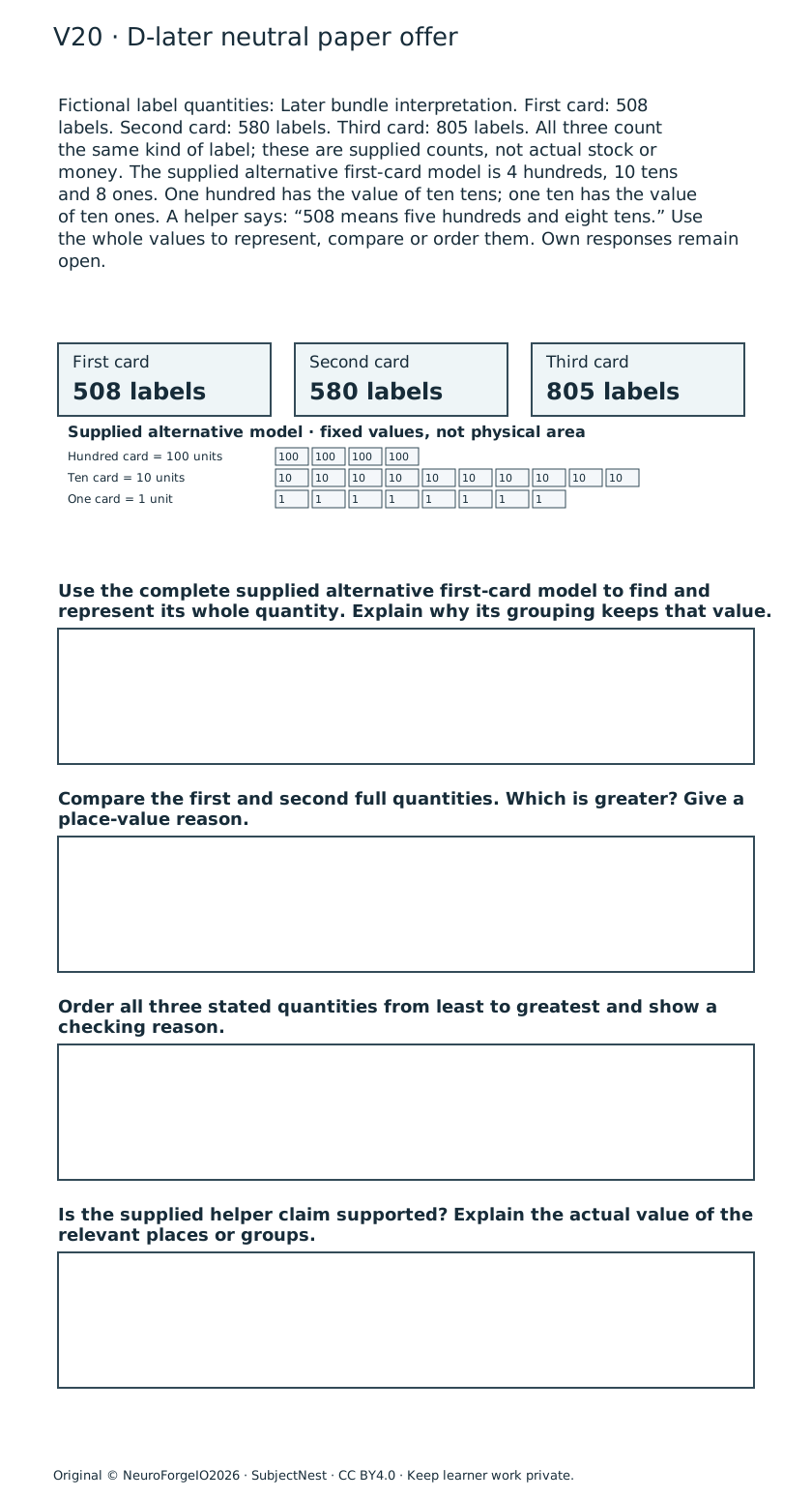
V20, complete neutral D-later paper offer. Whole supplied source: Fictional label quantities: Later bundle interpretation. First card: 508 labels. Second card: 580 labels. Third card: 805 labels. All three count the same kind of label; these are supplied counts, not actual stock or money. The supplied alternative first-card model is 4 hundreds, 10 tens and 8 ones. One hundred has the value of ten tens; one ten has the value of ten ones. A helper says: “508 means five hundreds and eight tens.” Use the whole values to represent, compare or order them. Own responses remain open. Three known source cards state first 508, second 580, third 805 labels, in that source order. A separate known panel depicts 4 hundred-value cards, 10 ten-value cards and 8 one-value cards. Each has its explicit 100/10/1 value legend, not physical-area scaling. No derived standard grouping is printed. Four exact prompts: 1. Use the complete supplied alternative first-card model to find and represent its whole quantity. Explain why its grouping keeps that value. 2. Compare the first and second full quantities. Which is greater? Give a place-value reason. 3. Order all three stated quantities from least to greatest and show a checking reason. 4. Is the supplied helper claim supported? Explain the actual value of the relevant places or groups. Four genuine empty own response regions: 1 at (60,650),720 by 140; 2 at (60,865),720 by 140; 3 at (60,1080),720 by 140; 4 at (60,1295),720 by 140. Prompt labels remain outside every white interior. No staff criterion, worked answer or NEXT teaching appears. Native own page/paper must use this exact whole source and four questions. A neutral reader, sign/AAC or exact scribe can deliver source/own words. This complete original alternative accompanies the generated vector asset; no administered assessment is claimed. The supplied alternative-model caption has baseline y 452, clearly below the source-card rule at y 430 and before the first token row at y 463. Token rows and all own response regions retain their original positions.