Keep a first clue before help
Choose a little clue challenge. Keep your own first idea before we talk it through.
Paper, telling/signing/AAC, private work, rest or finish are all okay. A helper can read the source or do the moving you choose.
Pick a way
(a) Private collector page: Answer one or more suitable components privately on a blank paper page, with full source nearby.
(b) Exact guided recording: Speak/sign/AAC/direct marks while a wanted helper records exact child choices; label adult operation.
(c) Ordinary mini challenge: Use O4 to make a useful two-item sort and an unknown field; do this when a held first is unsuitable.
Complete selected sources
O1 — The play-clue tray
Original fiction, three description cards recorded 2026. ItemP is a rectangular paper path with four broad spaces; its card says players choose a space in turns. ItemQ is a cloth square with a stitched star; its card does not describe how it was used. ItemR is a wooden wheel-shaped piece; its card says it was part of a toy cart. No card names a maker, owner or making date. The descriptions are supplied text, not a child's observation or an image of a real collection. These items can help a material question; the maker is unknown.
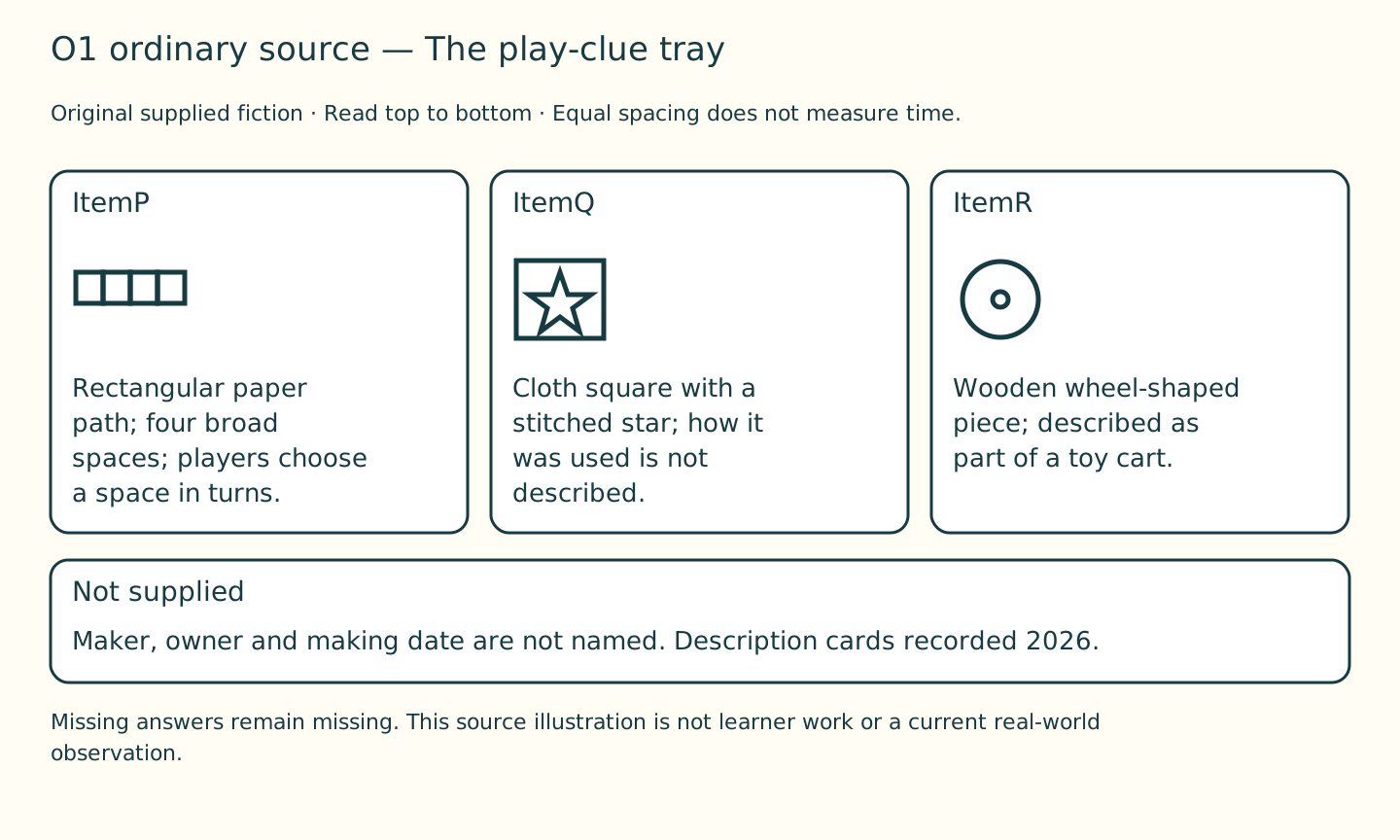
Whole drawing and complete text alternative.
Grown-up help
Offer one wanted route, not all three. Read the source neutrally, or support sign/AAC, dictation, broad marks and child-directed operation. Keep adult work separate. Rest, private work, pass or finish are valid options. Full teacher plan · Blank making mats.
Sources and reuse · Original educational work © NeuroForgeIO Pty Ltd 2026, CC BY 4.0. Linked authority/provider exceptions and learner ownership stay separate.